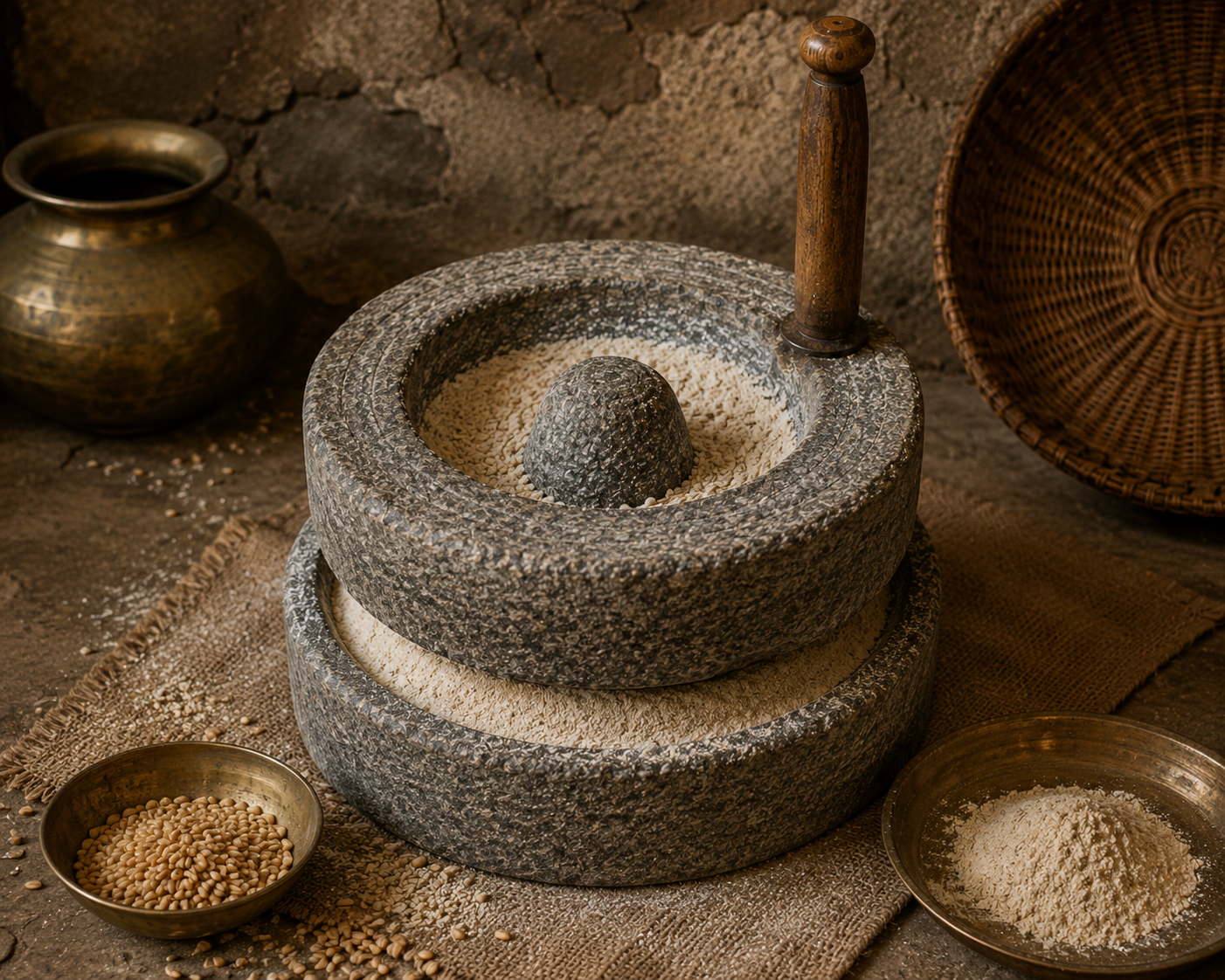
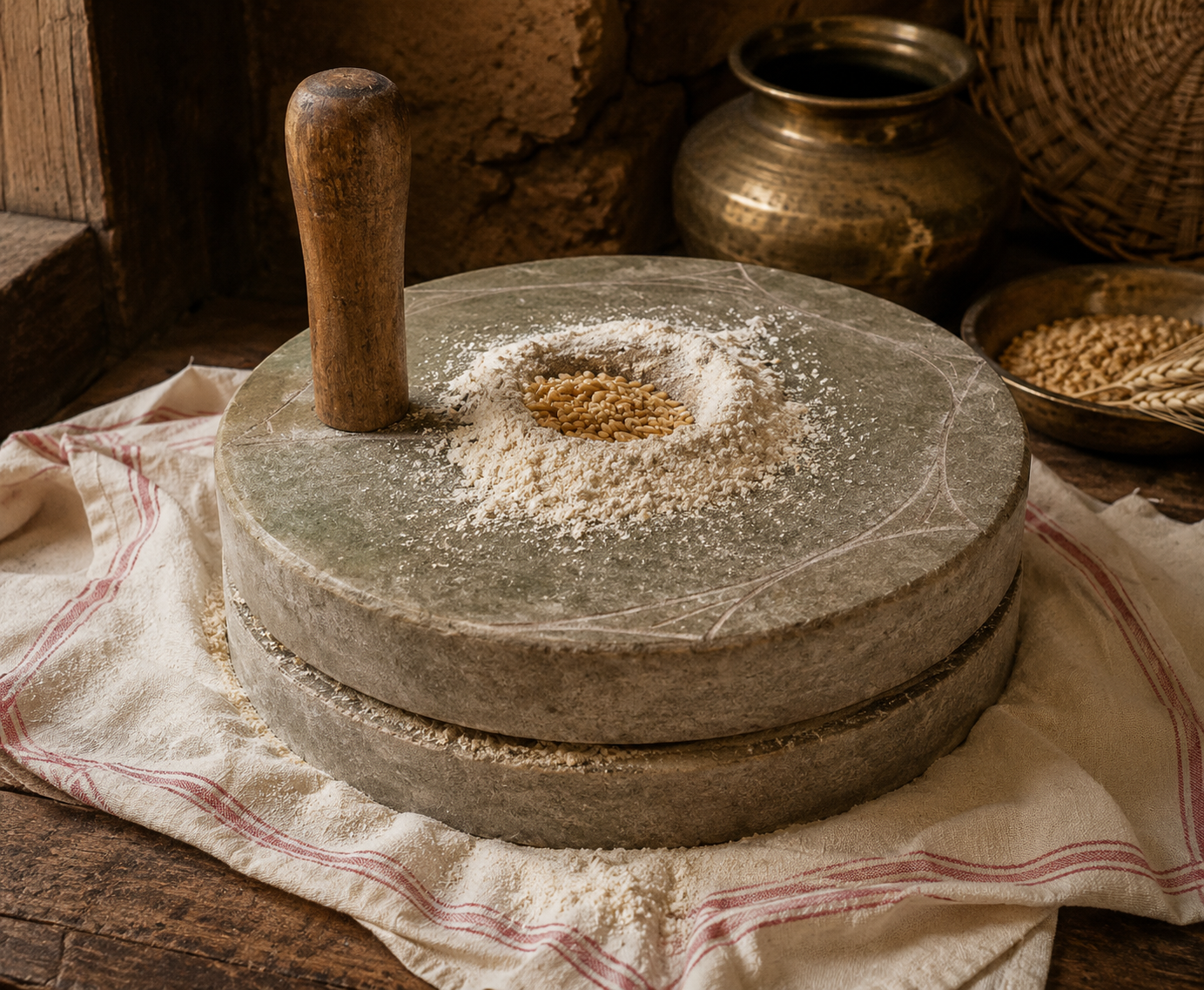
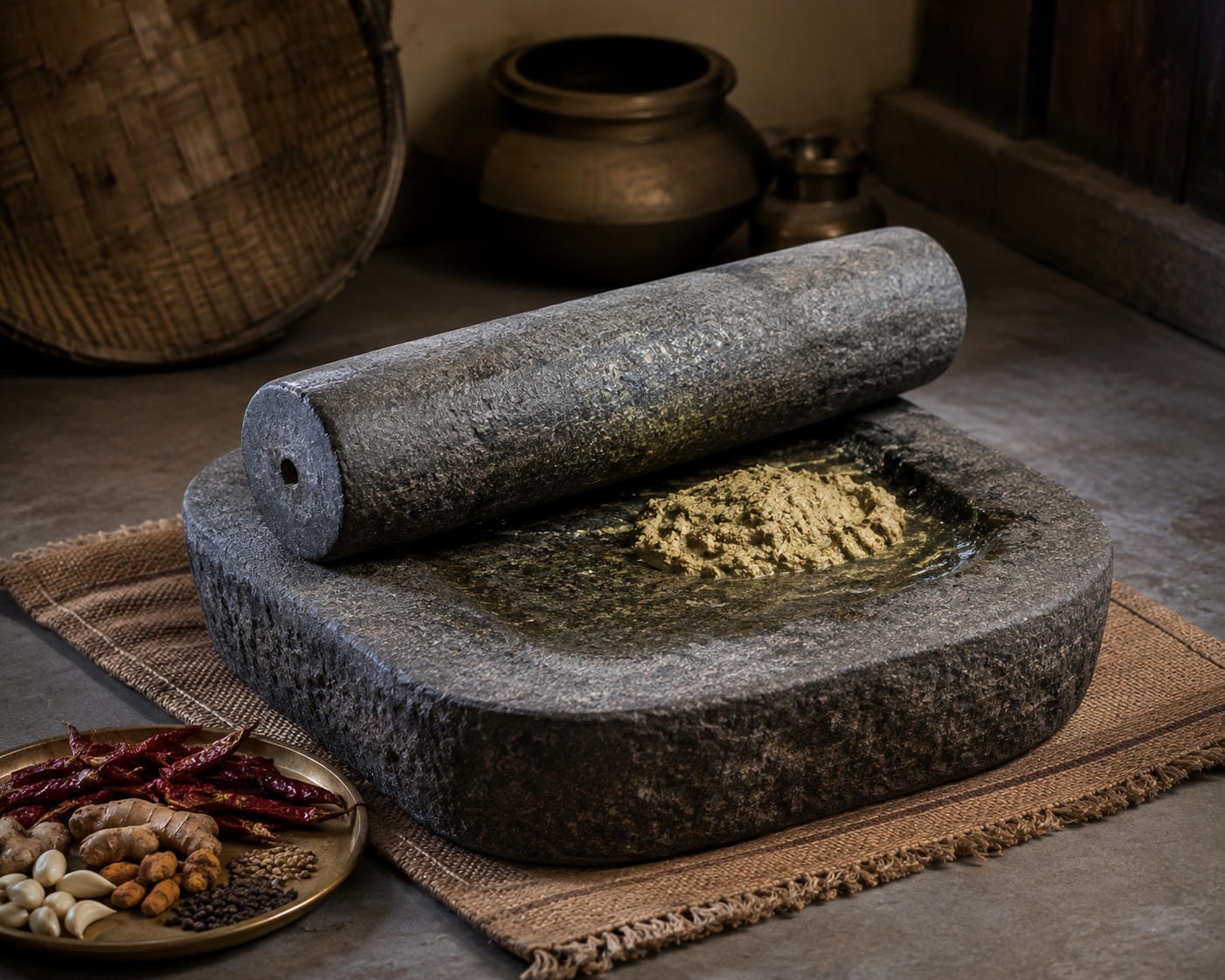
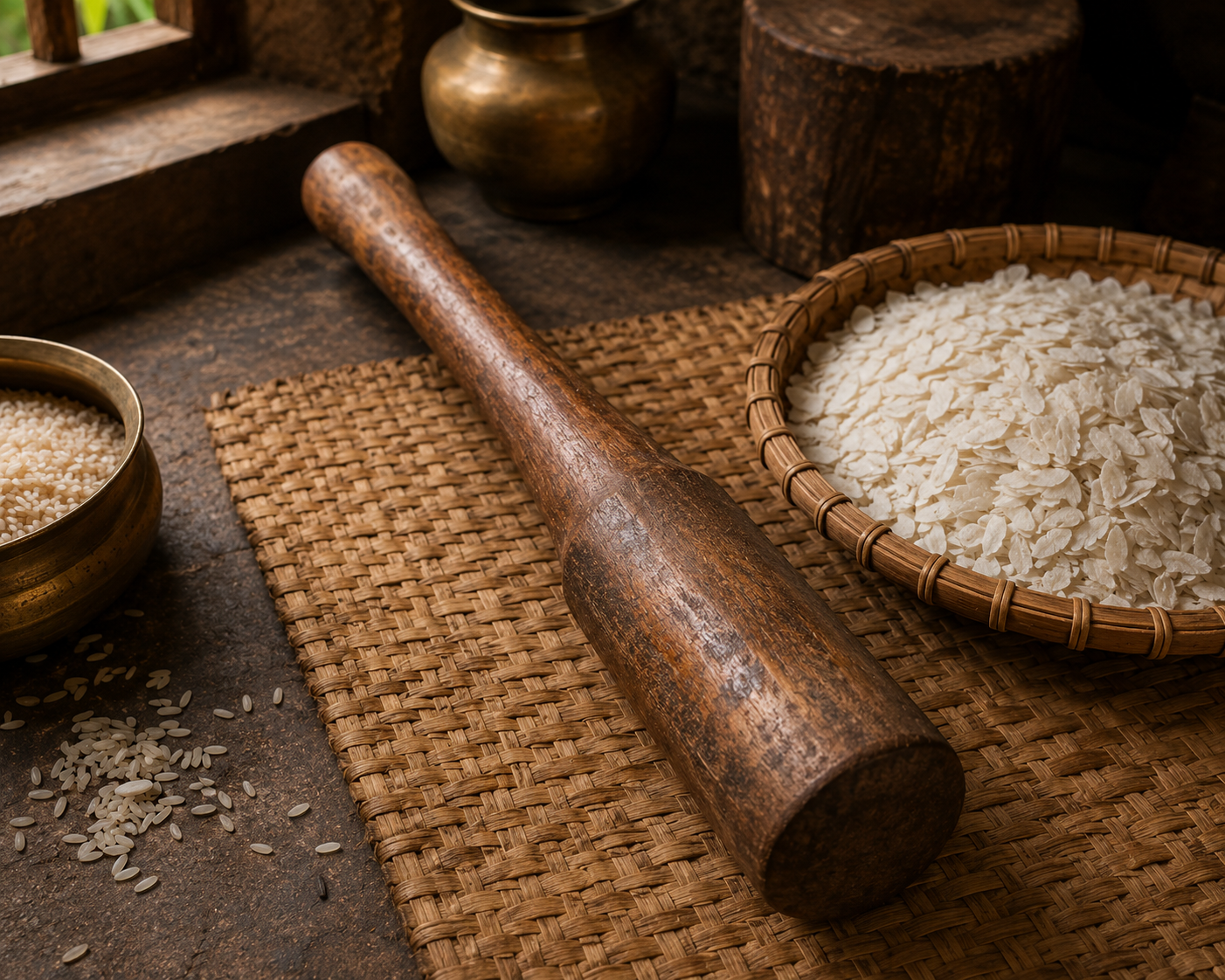
Beejo Kall consists of two closely fitted circular stone discs. The lower stone remains stationary while the upper stone rotates over it. The upper stone has a central opening through which grains or other ingredients are introduced. A wooden handle fixed into the upper stone provides the leverage required to rotate the heavy stone by hand.
As the upper stone turns, the ingredients pass between the two rough stone surfaces and are gradually crushed, ground or reduced to the required consistency. The user could control the grinding through the speed and pressure applied while turning the handle.
It was an important part of traditional kitchen technology, allowing households to process relatively small quantities of food ingredients without electricity or mechanised equipment.
Traditional use: Beejo Kall was traditionally used for:
Grinding grains and pulses
Crushing spices and dry ingredients
Preparing flour
Processing ingredients for daily cooking
Grinding small quantities according to household requirements
The hand-operated mechanism allowed the user to gradually grind ingredients and control their final texture
Cultural significance: Beejo Kall represents the traditional self-sufficient food-processing practices of Kodagu households. It transformed locally available grains and other ingredients into food preparations using nothing more than stone, wood and human effort.
It also reflects the importance of manual food preparation in traditional household life, where grinding was an everyday activity rather than an automated process.
Historical context: Before electric grinders and mechanised milling equipment became common, grinding was an essential household activity. Beejo Kall provided a simple and dependable means of processing food using human energy and locally available natural materials.
The principal craftsmanship lies in the shaping and fitting of the two heavy stones so that the upper stone rotates smoothly while maintaining effective contact with the lower grinding surface.
The wooden handle is another distinctive feature, providing the leverage needed to operate the heavy upper stone manually. Its simple mechanical principle makes the Beejo Kall an excellent example of traditional technology developed without modern machinery.
Reason for decline: The use of Beejo Kall declined with the introduction of electric mixers, grinders, flour mills and other mechanised kitchen equipment. These appliances made grinding considerably faster and required much less physical effort.
Changing lifestyles and the gradual disappearance of traditional household food-processing practices further reduced the need for large hand-operated stone mills.
Revival efforts: Beejo Kall can be revived through heritage kitchens, museums, cultural demonstrations and traditional food programmes. Surviving examples can be restored and demonstrated to younger generations to explain how grains, pulses and spices were traditionally processed.
Traditional cooking demonstrations using Beejo Kall can also help preserve the practical knowledge associated with operating the mill and the food preparations made with it.
You are preserving Beejo Kall / Beejwa Kall — Stone Hand Mill / Rotary Grain Mill.