Storage · Kitchen Storage & Food Preservation
Aal Potti,ಆಲ್ ಪೊಟ್ಟಿ
Traditional Wooden Cupboard
Also written: ಆಲ್ ಪೊಟ್ಟಿ
Preserved by a custodian
| ||||||||||||||||||||||||
| ||||||||||||||||||||||||
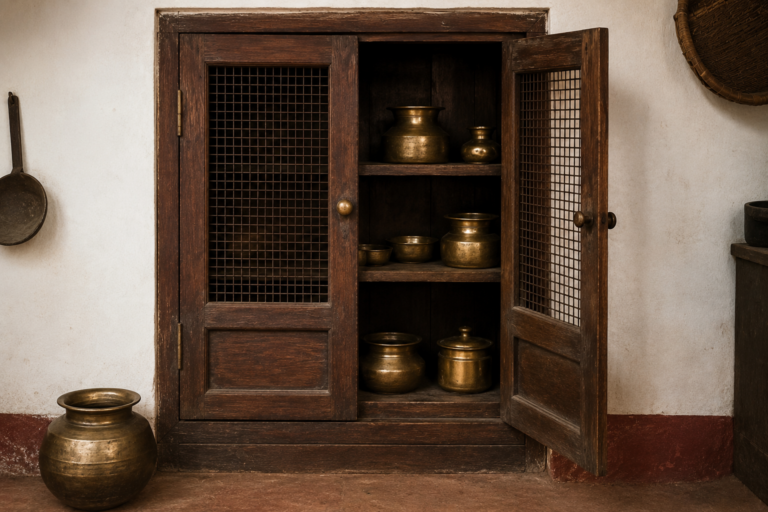
The Aal Potti was an integral storage feature of the traditional Kodava household. Built against a wall in or close to the kitchen, it functioned as a cupboard for keeping prepared food, cooking equipment and vessels.
Traditional Aal Pottis could incorporate a thin mesh-like covering or ventilated surface that permitted air to circulate through the cabinet. This was particularly useful for storing leftover cooked food and wet vessels after meals.
Unlike the modern refrigerator and enclosed metal or modular kitchen cabinets, the Aal Potti formed part of the architecture and everyday functioning of the traditional home. Examples can still be found in some old independent houses and Ainmanes in Kodagu, although the feature has become increasingly uncommon
Traditional use: Storing leftover or prepared food
Storing wet vessels after use
Keeping cooking utensils and kitchen equipment
Providing an accessible storage space within or near the kitchen
Allowing air circulation through its ventilated covering
Cultural significance: The Aal Potti continues to have significance in traditional Kodava households. Even today, in some old houses and Ainmanes, it is retained in the kitchen and used to keep sacred items associated with daily household practices, including the daily Meedi (ritual offering) made in remembrance of ancestors.
This continued use demonstrates that the Aal Potti is not merely a storage cupboard but can form part of the living ritual space of the Kodava household. Its preservation in old homes reflects the continuity of ancestral traditions and the close relationship between everyday domestic life, food, and remembrance of ancestors.
Historical context: The existing source tentatively places its use from around the 13th–14th century onward, corresponding to the period when houses were constructed using wood and brick. The continued presence of similar cupboards in old Ainmanes is cited as evidence of their longstanding use. This dating should be treated as tentative rather than definitively established until supported by architectural or historical research.
The Aal Potti was traditionally constructed as a built-in wooden cupboard. Wooden planks were used to form the cabinet and shutters, with ventilation incorporated through a mesh-like covering or openings. It was positioned against a wall, generally in or near the kitchen
Reason for decline: The Aal Potti has declined primarily because modern households have adopted refrigerators, metal cupboards and other contemporary storage solutions. The original source notes that modern, more user-friendly materials such as iron have also replaced traditional wooden constructions in many homes
Revival efforts: The Aal Potti is still preserved and used in some old Kodava houses and Ainmanes, particularly in the kitchen. Its continued use for storing sacred household items and the daily Meedi offered in remembrance of ancestors is itself an important form of cultural preservation.
As part of revival efforts, Aal Pottis can be retained or recreated in renovated traditional homes and new Kodava houses, rather than being replaced entirely by modern cupboards. Documenting their traditional design, construction and continued ritual use through the Virtual Museum can further encourage younger generations to understand and preserve this distinctive element of Kodava domestic heritage.