

Agistike (ಅಗಸ್ಟಿಕೆ)
Contents
Agistike (ಅಗಸ್ಟಿಕೆ)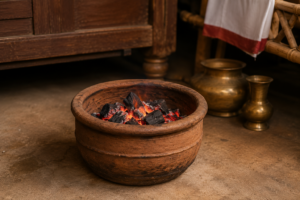
Overview
Agistike is a traditional clay vessel used to hold burning embers or charcoal in Kodava households. It was a simple but versatile household object that provided heat for cooking, drying, warming and other everyday activities.The Agistike reflects the practical knowledge of earlier generations, who made effective use of fire and embers in a climate where Kodagu’s cool, wet seasons made warmth and controlled heat particularly valuable.
Traditional Use
The Agistike was traditionally filled with glowing charcoal or embers and placed wherever a steady source of heat was required.During the cold and rainy months, it could be used to provide warmth inside the house. During the monsoon, an Agistike was sometimes placed beneath a Balnji, a traditional wooden or bamboo clothes rack, to help dry damp clothing.
Its usefulness extended well beyond heating.
Uses of the Agistike
- Keeping warm: Providing heat during the cold and wet seasons.
- Drying clothes: Helping dry damp clothes during the monsoon.
- Cooking and warming food: Embers could be used for cooking or keeping food warm.
- Working with metal: The heat was useful for sharpening spearheads and other metal implements.
- Pottery: Used as a source of heat for baking or firing pottery.
- Outdoor activities: Provided a portable source of heat when working outdoors.
- Ceremonial purposes: Fire and embers also had a place in traditional religious and ceremonial practices.
Agistike at the Dining Table
One of the interesting uses of the Agistike was associated with food. Traditionally, a clay ember container could be placed on or near the dining area with hot charcoal inside.The heat could be used to cook, finish or keep certain foods warm while they were being served. This demonstrates how a single household object could serve several purposes rather than being restricted to one particular function.
Materials and Form
The traditional Agistike was generally made from clay, shaped as a sturdy container capable of holding hot embers.Its design was functional rather than decorative. The vessel had to withstand heat while remaining practical enough to be moved or positioned wherever warmth was needed.
A Reflection of Traditional Kodava Life
The Agistike is an example of the resourcefulness embedded in traditional Kodava household life. Before modern heating appliances, electric dryers and contemporary cooking equipment, households relied on simple objects that could perform several functions.
The Agistike transformed a small quantity of burning charcoal into a useful source of heat, warmth and controlled fire.
Heritage Significance
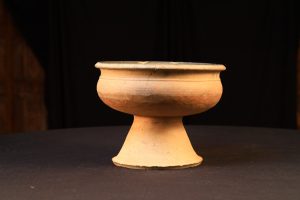
Although it may appear to be an ordinary clay vessel, the Agistike represents an important part of the material culture of Kodagu. It connects us to a period when household practices were closely adapted to the local environment and available resources.
Objects such as the Agistike are important to document because they preserve not only the object itself, but also the knowledge of how earlier generations lived and used their surroundings.
Today, surviving Agistikes can be regarded as heritage artefacts that offer a glimpse into the practical and self-sufficient lifestyle of traditional Kodava households.
Virtual Modha goode
- Virtiual Modhagood – The virtual Museum of Kodava Heritage.
Comments
Leave a comment!Login for Post Comment
Last posts