

Kothiri
Contents
Kothiri ಕೊತಿರಿ
English Name
Traditional Temporary Ritual Wick 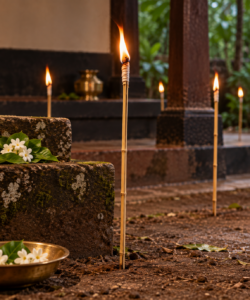
Alternate Names
Makeshift ritual wick; temporary oil wick
Short Description
A very slender strip of split bamboo, approximately one and a half feet long, with one end wrapped in cloth. The cloth is dipped in oil and lit, creating a temporary flame and smoke.
Full Description
Kothiri is a simple, single-use lighting implement traditionally made from a thin strip of split bamboo or cane. One end of the strip is wrapped with a small piece of cloth, which is dipped in oil and then ignited.
Unlike a conventional oil lamp, Kothiri does not have a permanent container or lamp body. It functions as a temporary wick, providing light and smoke for the duration of its burning.
Kothiri continues to have a place in Kodava ritual practice, particularly during Meedi and Karona, the annual observances associated with ancestor worship. Its significance extends beyond illumination, as the smoke from the burning wick helped keep insects and small animals away from ritual offerings.
Traditional Use
- Used as a temporary substitute for a lamp during ritual occasions.
- Prepared for single use and discarded after burning.
- Used particularly during Meedi and Karona rituals.
- Provided a flame and continuous smoke while burning.
- Helped protect ritual offerings from insects and small animals.
Materials
- Thin strip of split bamboo or cane
- Cloth
- Oil
Design & Form
Kothiri is deliberately simple and slender. It consists of a narrow, split strip of bamboo or cane, approximately one and a half feet long.
A small portion of cloth is wrapped around one end to form the wick. The remaining length serves as the support or handle. There is no separate lamp vessel or permanent structure.
Method of Making
A thin strip is split from a piece of bamboo or cane and cut to the required length. Cloth is wrapped around one end of the strip. The cloth is then soaked in oil before the Kothiri is lit.
Method of Use
The cloth-wrapped end is dipped in oil and ignited. Once lit, the oil-soaked cloth burns gradually, producing both flame and smoke.
The Kothiri may be positioned or fixed vertically in the ground near the ritual setting, allowing it to burn for the required period without the need to hold it.
Traditional Knowledge
Kothiri reflects an understanding of the practical properties of fire, oil and smoke. The burning wick produced smoke that helped discourage insects and small animals from approaching ritual offerings.
This practical function was closely connected with a traditional belief concerning ancestral offerings. Offerings made during ancestor worship were intended for the ancestors and were considered more respectfully maintained when they could remain undisturbed for a longer period. Preventing insects and small animals from consuming or disturbing the offerings was therefore considered important.
The principle also has a familiar parallel in the later and present-day use of incense sticks, where burning material produces fumes that help keep insects away while serving a ritual purpose.
Cultural Context
Kothiri remains part of living Kodava ritual practice. It is particularly associated with Meedi and Karona, annual observances connected with the remembrance and worship of ancestors.
Its presence during these rituals represents the combination of practical necessity and ritual belief that characterises many traditional objects. A simple strip of bamboo becomes a temporary source of light and smoke, while also helping preserve the offerings placed for the ancestors.
Traditional Location / Setting
Kothiri is used within the ritual setting where ancestral offerings and observances take place, particularly during annual Meedi and Karona ceremonies.
Ritual & Practices
During the ritual, the Kothiri is prepared by wrapping cloth around one end of a thin split bamboo strip. The cloth is soaked in oil and ignited.
The burning Kothiri provides a temporary flame and produces smoke around the offerings. Traditionally, this was understood to help prevent insects and small animals from disturbing or consuming the offerings while they remained placed for the ancestors.
Historical Context
Kothiri represents an older form of temporary illumination and ritual practice in which simple materials available in the local environment were adapted for a specific purpose.
Although modern forms of lighting have replaced such implements for everyday illumination, the Kothiri has survived within ritual practice because its meaning and practical function remain relevant during ancestral observances.
Evolution & Changes
The basic form of Kothiri remains simple and has not required substantial modification. Modern lighting may be available around ritual spaces, but Kothiri continues to be prepared for its traditional ritual purpose.
Its function can also be understood in relation to the continuing use of incense sticks, where burning material produces fumes that help discourage insects.
Reason for Decline
Not applicable. Kothiri has not disappeared from use. Its everyday lighting function has become unnecessary because of modern lighting, but its ritual use continues.
Present Status
Kothiri is a living traditional object and continues to be used during Kodava rituals, particularly Meedi and Karona.
Its continued use demonstrates that traditional objects can survive not because they are technologically necessary, but because they retain ritual, cultural and symbolic significance.
Revival & Continued Use
Kothiri does not require revival. It continues to be made and used as part of traditional ancestral observances.
Its continued presence in Meedi and Karona provides an important example of the transmission of traditional knowledge and ritual practice from one generation to another.
Preservation
For museum documentation, the following should be recorded:
- Traditional name and terminology
- A physical example of the bamboo strip
- Approximate length and thickness
- Type and preparation of bamboo or cane
- Method of splitting the bamboo
- Type of cloth used
- Oil used for burning
- Method of wrapping and soaking the wick
- Method of positioning or fixing it during rituals
- Ritual occasions on which it is used
- Its relationship to ancestral offerings
- Oral histories and explanations from practitioners
- Photographs or video documentation of its use during Meedi and Karona
Historical & Cultural Importance
Kothiri is a small but significant example of living Kodava material culture. Its construction is extremely simple, yet its use brings together illumination, smoke, protection of offerings and ancestral belief.
The practice reflects the traditional understanding that offerings made to ancestors should remain undisturbed for as long as possible. The smoke produced by the burning wick helped discourage insects and small animals from consuming or disturbing the offerings, giving a practical purpose to an object that also formed part of the ritual environment.
Its continued use during Meedi and Karona makes Kothiri particularly important to a virtual museum. It is not merely an obsolete lighting device; it is a living ritual object that preserves traditional knowledge, practice and belief within contemporary Kodava ancestral worship.
Virtual Modha goode
- To see many articles like these click on Virtiual Modhagood – The virtual Museum
Comments
Leave a comment!Login for Post Comment
Last posts