

Udhi
Contents
Udhi ಉಧಿ
English Name:
Traditional Rope Hanging Holder
Alternate Names: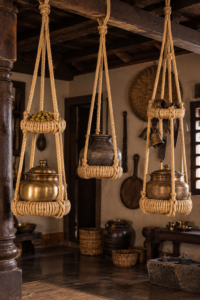
Butter Pot Holder; Hanging Storage Unit
Short Description:
Udhi is a traditional rope-made hanging holder used to suspend a butter pot or vessel. Its suspended form keeps the vessel elevated and secure, and similar rope arrangements were also used for storing small household items such as cardamom and cow bells.
Full Description:
Udhi is made from strong rope arranged into a suspended framework with a loop or basket-like support at the lower end. The upper end is tied securely to a beam, hook or other overhead support, allowing the vessel or stored object to remain suspended above the ground. It represents a simple traditional method of storage using rope and vertical space.
Traditional Use:
Used primarily for hanging and holding butter pots and other vessels. The elevated position helped keep stored items away from the floor and protected them during everyday household use.
Design & Form:
The Udhi consists of several lengths of rope gathered at the top and spreading downward into a supporting frame. A circular or basket-like rope cradle at the bottom holds the pot or object securely.
Materials:
Traditionally made from strong natural fibre rope.
Method of Making:
Lengths of rope are measured, joined and knotted to create the upper suspension and lower supporting cradle. The ropes are arranged so that the weight is distributed evenly when the holder is suspended.
Method of Use:
The upper end is securely attached to an overhead point. A butter pot or other vessel is placed within the lower rope cradle, allowing it to hang freely above the ground.
Traditional Knowledge:
The making of Udhi demonstrates knowledge of rope selection, knotting, weight distribution and secure suspension. Its construction reflects an understanding of simple but effective household storage using locally available materials.
Cultural Context:
Udhi belongs to the traditional household material culture of Kodagu, reflecting practical methods used to store and suspend everyday objects within the home.
Traditional Location / Setting:
Traditionally found in household interiors, particularly where overhead beams or other suitable supports were available.
Ritual & Practices:
Its primary function was practical household storage rather than a ritual object. Depending on its use, it could hold vessels or other small household articles.
Historical Context:
Udhi represents an older household practice in which everyday storage relied on handmade rope structures rather than modern cupboards, shelves and storage containers.
Evolution & Changes:
Modern storage systems and manufactured containers have reduced the everyday need for such rope hanging holders. However, the principle of suspending objects using rope remains a simple and effective traditional practice.
Reason for Decline:
The use of Udhi declined as modern kitchens and homes adopted cupboards, shelves, hooks and purpose-built storage systems.
Present Status:
The traditional form is now less commonly encountered in everyday household use, but examples may survive in older homes and heritage collections.
Revival & Continued Use:
Its preservation as a traditional household object helps document earlier storage practices and the practical use of rope craftsmanship in Kodagu.
Preservation:
The Udhi should be documented through photographs, measurements, rope material, knotting techniques, method of suspension and the objects traditionally placed in it. Oral histories from older generations can help record its different household uses.
Historical & Cultural Importance:
Udhi is a small but significant example of traditional Kodava household ingenuity. Its simple rope construction demonstrates how everyday storage needs were met with locally available materials, practical knowledge and minimal resources.
Virtiual Modhagood
To explore more articles on Kodava heritage, customs, attire, artifacts, and traditions, visit Virtiual Modhagood – The virtual Museum
Comments
Leave a comment!Login for Post Comment
Last posts