About the Object
A long traditional cloth worn by Kodava women as part of attire over the head to cover the hair.
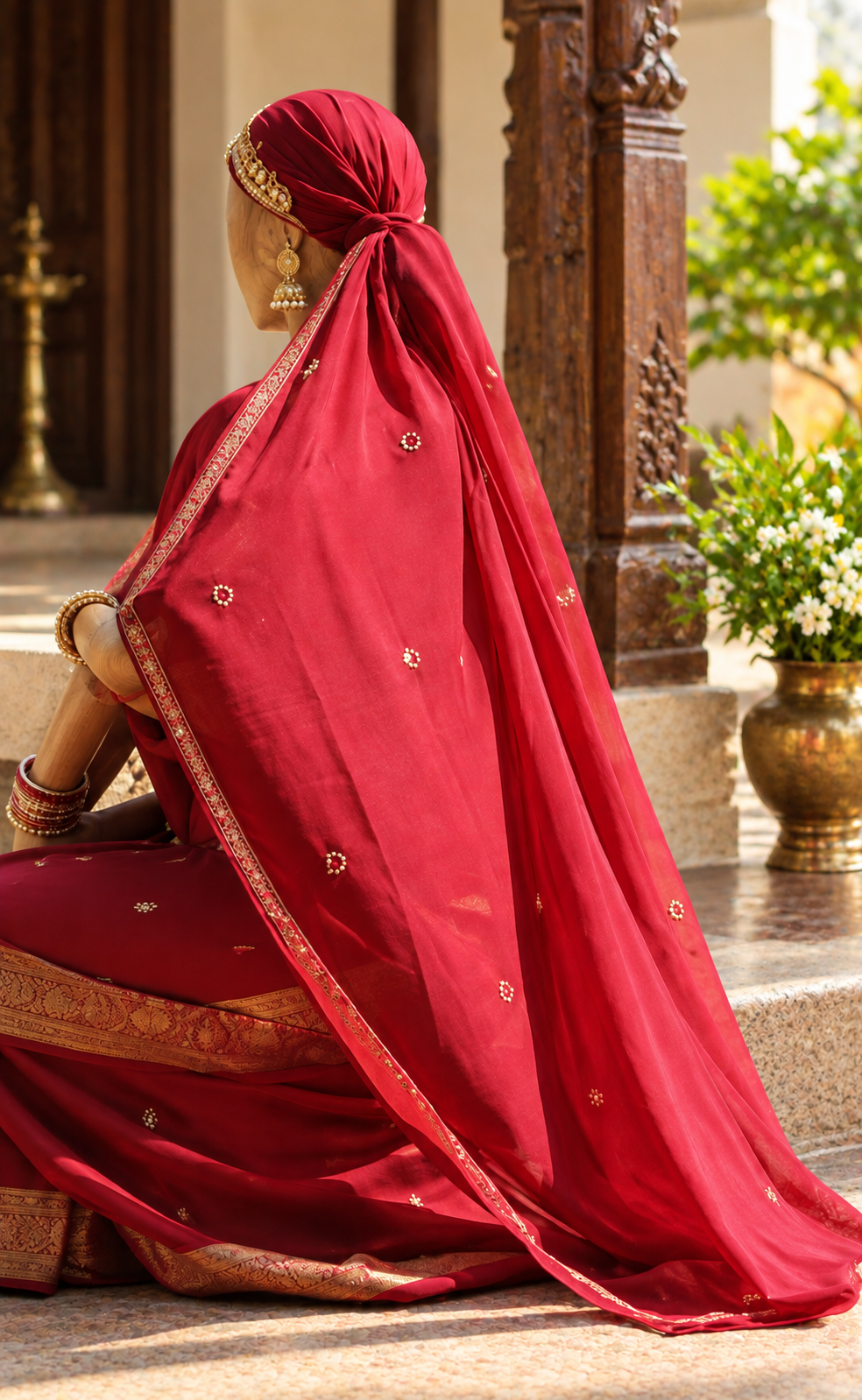
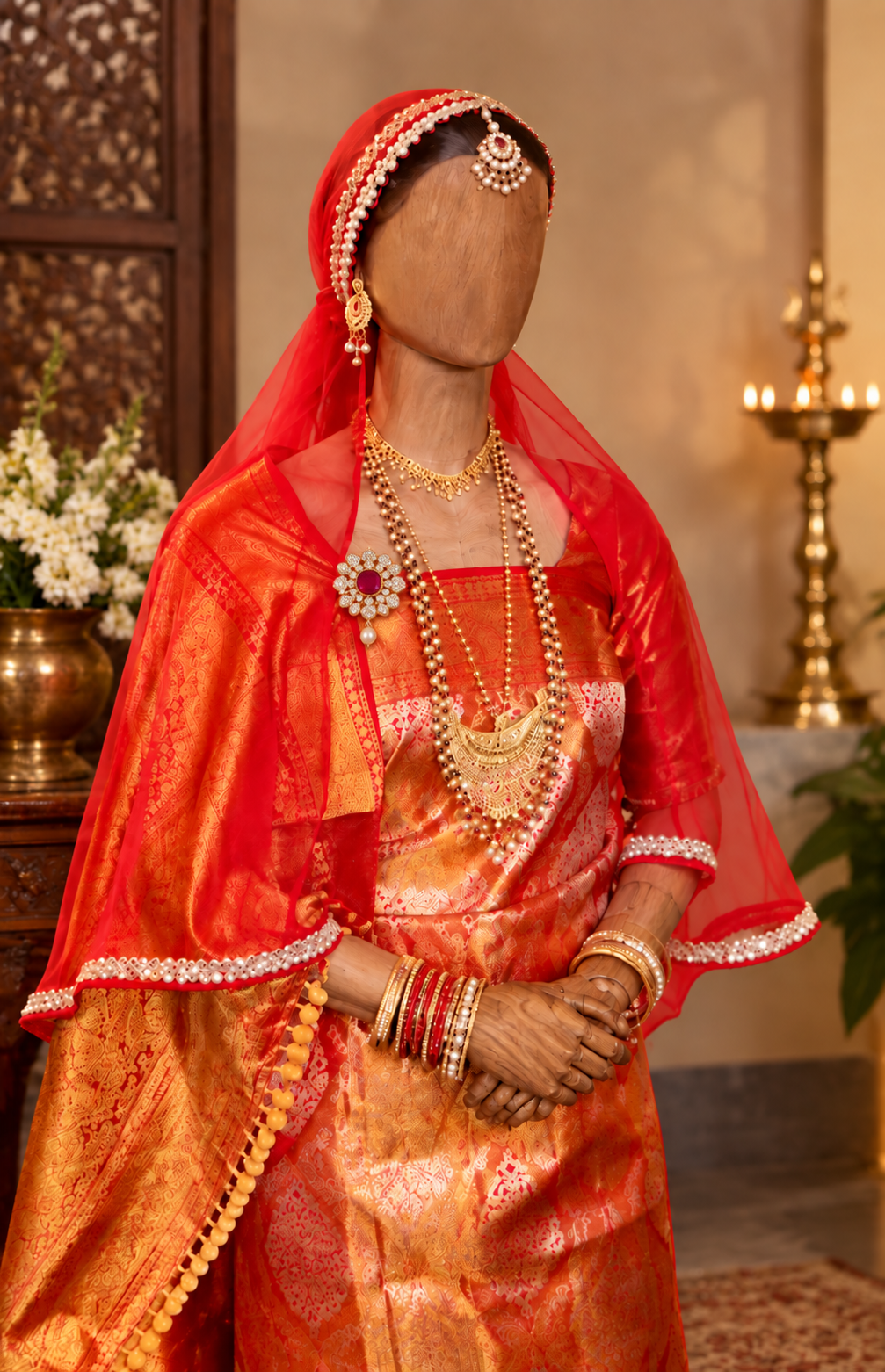
The women’s Vastra is a distinctive textile element of traditional Kodava women’s dress. It is a long, flowing piece of fabric arranged over the head and upper body, creating a graceful veil-like covering while allowing the saree worn underneath to remain visible.
The Vastra may be made in rich colours and can feature ornamental borders, woven patterns, embroidery, zari work, small motifs and decorative edging. Ceremonial and bridal versions are often more elaborate than simpler forms. The fabric is arranged so that the decorated border remains visible along the edge as the Vastra falls over the shoulders and extends down the back.
The way the Vastra is folded, positioned and draped is an important part of traditional dressing knowledge. Its appearance can vary according to the occasion, the textile used and the preferences of the family or wearer. In a traditional bridal ensemble, the Vastra works together with the saree and jewellery to create a distinctive ceremonial appearance
How It Was Used
Traditional use: The Vastra was traditionally worn by women during weddings, family ceremonies, festivals and other significant social occasions. It was especially important as part of bridal attire, where it was placed over the head and shoulders and allowed to flow down the back.
The cloth could be arranged in different ways to provide a modest covering of the head and upper body while also displaying its decorative border and embroidery. During ceremonies, the Vastra complemented the traditional saree and jewellery and helped distinguish the formal appearance of the bride from everyday dress.
The knowledge of properly folding, placing and draping the Vastra was traditionally passed from older women to younger generations through observation and practice. Thus, its use involved not only the textile itself but also knowledge of how it should be worn on an important occasion.
Cultural significance: The women’s Vastra represents an important part of Kodava textile, clothing and bridal heritage. Its characteristic draping gives traditional Kodava women’s ceremonial dress a distinctive visual identity.
The Vastra also reflects the importance attached to clothing during major family and community occasions. A specially prepared or richly decorated Vastra could signify the importance of the occasion and contribute to the dignity and elegance of the wearer.
Its cultural value extends beyond its decorative appearance. The cloth carries knowledge of traditional dressing practices—how it is folded, where it is placed, how the border is displayed and how it is coordinated with the saree and jewellery. In this sense, the Vastra represents both tangible textile heritage and intangible knowledge of traditional dress.
Its continued use at Kodava weddings and cultural events helps maintain a visible connection between contemporary generations and earlier traditions
Historical context: The women’s Vastra belongs to an older tradition of Kodava clothing in which lengths of woven textile served multiple purposes beyond simple body covering. Clothing was closely connected with social identity, family occasions and ceremonial presentation.
In earlier generations, traditional dress was prepared, maintained and worn according to established practices. The Vastra formed part of this larger clothing system and was particularly associated with occasions where women dressed in their traditional finery.
Over generations, fabrics, colours, decorative techniques and styles have changed, but the fundamental concept of a long ceremonial cloth draped over the head and shoulders has remained recognizable.
Material & Making
Cotton
Traditionally made from cotton or silk, with ceremonial versions using finer or richer fabrics. Decorative borders, embroidery, zari and other embellishments may be incorporated depending on the type and period of the Vastra.
Traditionally, the fabric was produced by weaving yarn into a long rectangular textile, after which the cloth could be finished with borders or other decorative work. More elaborate versions could receive embroidery, woven motifs, zari or ornamental edging.
The making of a traditional Vastra involved knowledge of textile selection, weaving, border construction, finishing and decoration. The final cloth had to be sufficiently long and flexible to allow it to be folded and draped over the head and shoulders.
Historically, decorative work would have been carried out using skilled hand techniques, with the quality and complexity depending on the purpose of the cloth. Bridal and ceremonial examples could therefore become highly elaborate textile pieces.
Who Used It? / Where? / When?
OwnershipNot yet recorded
Period
Ancient
Status of traditionStill used ceremonially
The Tradition Today
Reason for decline: Its everyday use has reduced considerably as modern clothing has become more common. However, this does not represent complete disappearance, as the Vastra continues to be used during Kodava weddings and cultural occasions.
Revival efforts: Its continued presence in traditional weddings, cultural programmes and heritage events provides an opportunity for younger generations to learn both the appearance of the Vastra and the traditional method of wearing it.
Sources
Source not recorded