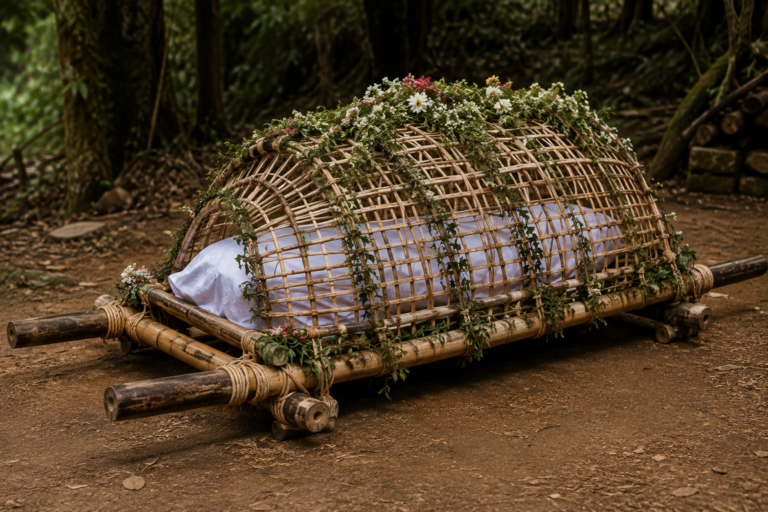
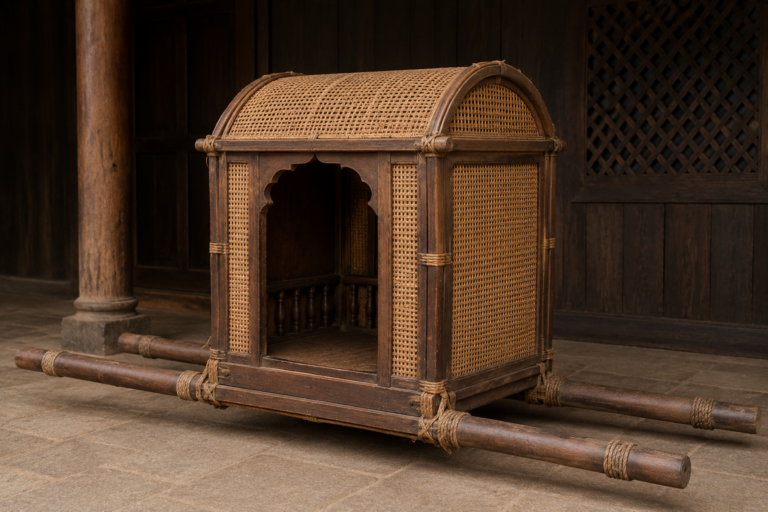
The Funeral Andhol is a traditional structure used during the final journey of a deceased person in Kodava funeral practices. It consists of a sturdy raised platform with an arched or dome-shaped framework made primarily from bamboo and cane. The deceased was respectfully placed on the platform and covered with cloth, while the domed framework provided a dignified enclosure. The structure was carried by family members, relatives or members of the community from the home to the place of cremation or burial.
Cultural significance: The Funeral Andhol represents respect for the deceased, responsibility towards the family and collective community participation. The act of carrying the deceased together reflects the communal nature of traditional Kodava funeral customs.
Historical context: The Andhol belongs to an older tradition of Kodava funeral practices in which important ceremonial structures were made using natural materials available within the local environment. The traditional term Andhol has gradually been replaced in Kodava usage by Chatta, reflecting linguistic changes and the influence of Kannada terminology.
The Andhol was constructed as a sturdy raised platform, with wooden components forming the structural base. In some cases, a cane-like dome structure was made over the platform, creating the characteristic arched enclosure. Bamboo and cane were shaped, woven or tied together using natural fibres to create a strong yet relatively lightweight structure.
You are preserving Chatta Andhol (ಆಂಧೋಲ್) — Funeral Bier.