

Thaya
Contents
Thaya ಥಾಯ
English Name 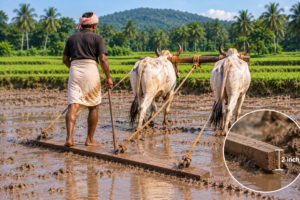
Traditional Paddy Field Levelling Implement
Short Description
A heavy wooden implement used especially in paddy fields to level and firm the soil. It was traditionally attached to the Noga (yoke) of a pair of oxen and dragged across the field.
Full Description
Thaya is a traditional wooden agricultural implement used primarily for levelling paddy fields after the soil has been ploughed and worked. Its broad and heavy wooden body helped break down uneven portions of soil and create a relatively smooth and level surface suitable for paddy cultivation.
The Thaya was traditionally tied or connected to the Noga (wooden yoke) of a pair of oxen. As the oxen moved across the wet or prepared paddy field, the Thaya was pulled behind them, pressing and levelling the soil.
This simple but effective implement reflects the traditional knowledge of paddy cultivation in Kodagu, where farmers used locally available timber and bullock power for field preparation.
Traditional Use
- Used especially for levelling paddy fields
- Used after ploughing and preparation of the field
- Attached to the Noga (yoke) of a pair of oxen
- Dragged across the field by the oxen
- Helped flatten uneven soil and firm the field surface
Design & Form
The Thaya is a broad, heavy and sturdy wooden implement designed to remain in contact with the soil as it is pulled. Its weight and flat working surface enabled it to press down and level the soil effectively.
Materials
Traditionally made from strong, durable local timber capable of withstanding continuous contact with wet soil and the pulling force of oxen.
Method of Making
A suitable piece of timber was selected and shaped into a strong, broad implement. The edges and surfaces were finished sufficiently smooth for use in the field, while the attachment point was made suitable for connecting it to the Noga.
Method of Use
The Thaya was secured to the Noga of the oxen using traditional rope or wooden fastening arrangements. As the oxen walked through the paddy field, the implement was pulled over the prepared soil, levelling and firming the surface.
Craftsmanship / Special Features
Its simple construction relied on the weight and strength of wood rather than complex mechanical parts. The size, weight and shape were determined by the nature of the paddy field and the power of the bullocks used.
Traditional Knowledge
Farmers understood the appropriate stage at which to use the Thaya, particularly when the paddy field had sufficient moisture for the implement to effectively level the soil.
Agricultural Context
The Thaya was an important implement in traditional wetland paddy cultivation. Proper levelling was essential for maintaining an even distribution of water throughout the paddy field.
Traditional Location / Setting
Primarily used in paddy fields of Kodagu, particularly during preparation of the field before paddy planting.
Historical Context
The Thaya represents the traditional system of paddy cultivation in which farmers depended on oxen, wooden implements and skilled manual knowledge rather than tractors and mechanical levellers.
Evolution & Changes
Its use declined with the introduction of tractors, power tillers and modern mechanical land-levelling equipment.
Present Status
The Thaya is now mainly preserved as an example of traditional agricultural heritage. Older implements may still be found in farming households and collections.
Preservation
The Thaya should be documented along with the Noga and other associated agricultural implements, including its dimensions, type of wood, method of attachment and traditional method of use.
Historical & Cultural Importance
The Thaya is an important example of traditional Kodagu paddy-field technology. Its connection to the Noga and oxen demonstrates how different agricultural implements worked together as part of a traditional farming system.
It represents the practical knowledge, craftsmanship and bullock-powered agricultural practices once central to paddy cultivation in Kodagu.
Comments
Leave a comment!Login for Post Comment
Last posts