

Peeche Kathi
Contents
Peeche Kathi
Peeche Kathi is a distinctive ornamental dagger of the Kodava community, traditionally worn by Kodava men as part of their ceremonial attire on important occasions.
Full Description
The Peeche Kathi is an ornamental dagger indigenous to the Kodava community of Kodagu. It forms an important part of traditional Kodava male attire and is worn on significant occasions. The handle is traditionally crafted in the form of a parrot or peacock, while the sheath can be richly decorated with silver, gold and precious stones. An intricately designed silver chain is attached to the sheath, often terminating in miniature replicas of traditional Kodava weapons. Silver tassels further enhance its elaborate appearance. The dagger is tucked into the chele of the Kodava man’s Kupya.
Traditional Use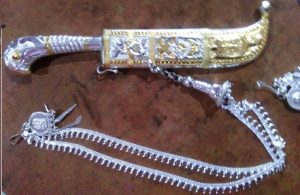 The Peeche Kathi is primarily worn as a ceremonial and traditional accessory rather than as an everyday weapon. It forms part of the complete traditional attire of Kodava men and is worn during important occasions, including weddings and festivals.
Cultural Significance
The Peeche Kathi is an important symbol of Kodava identity, tradition and ceremonial dress. Together with the Kupya, chele and other traditional accessories, it completes the distinctive attire of Kodava men. Its elaborate craftsmanship also reflects the importance given to weapons and weapon-inspired ornaments within Kodava cultural tradition.
Historical Context
Historically, weapons formed an important part of traditional Kodava male attire. The Peeche Kathi was incorporated into the ceremonial dress worn with the Kupya and Chele. Historical documentation of Kodava wedding attire identifies the Piche Kathi as part of the groom’s traditional ensemble, describing it as the Coorg ceremonial dagger with a silver or ivory hilt.
The Peeche Kathi is an ornamental dagger indigenous to the Kodava community of Coorg. It is used as a ceremonial accessory and is worn by Kodava men on important occasions.
Virtual Modha goode
- Virtiual Modhagood – The virtual Museum of Kodava Heritage.
Comments
Leave a comment!Login for Post Comment
Last posts