

Parle Balli keer ಬಿಲ್ಲೆ ಪರಲೆಬಳ್ಳಿ ಕೇರ್
Contents
Parle Balli keer ಬಿಲ್ಲೆ ಪರಲೆಬಳ್ಳಿ ಕೇರ್
English Name: Traditional Creeper Rope for Cattle
Alternate Names: Natural Creeper Rope; Cattle-Tying Rope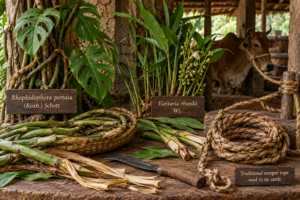
Short Description
Parla Balli was a traditional rope used for tying and securing cattle, made by processing strong, flexible forest creepers. The reference records creepers such as Rhaphidophora pertusa (Roxb.) Schott and Elettaria rheedii Wt. as materials used for making this rope.
Full Description
Parla Balli represents an older method of making functional rope from naturally available forest vegetation. Strong creepers were collected from the surrounding forests, processed and twisted or braided to form a durable rope suitable for tying cattle. It was a practical example of how traditional Kodava communities made everyday agricultural and livestock equipment from locally available natural resources.
Traditional Use
The rope was primarily used for tying cattle, securing them when required and managing livestock around the household and agricultural areas.
Design & Form
The finished material took the form of a long, flexible rope. Its strength and flexibility depended on the type of creeper selected and the manner in which the fibres or stems were prepared and twisted together.
Materials
Natural forest creepers, including Rhaphidophora pertusa and Elettaria rheedii, were used in making the rope.
Method of Making
Suitable creepers were collected and prepared for use. They were then twisted, joined or braided together to produce a sufficiently strong length of rope for tying cattle. The process relied on knowledge of which locally available creepers possessed the required strength and flexibility.
Traditional Knowledge
Making Parla Balli required knowledge of forest plants, their strength, flexibility and suitability for rope-making. This knowledge enabled people to identify useful creepers and transform them into practical livestock equipment without depending on manufactured materials.
Cultural Context
Parla Balli reflects the close relationship between traditional Kodava life, livestock rearing, agriculture and the natural environment of Kodagu. Forest vegetation was not only a source of food and medicine but also provided materials for everyday tools and household requirements.
Traditional Location / Setting
It was used around traditional households, cattle sheds and agricultural areas where cattle were kept and managed.
Ritual & Practices
Parla Balli was primarily a functional livestock implement rather than a ritual object.
Historical Context
The practice belongs to an earlier period when household and agricultural requirements were met largely through locally available natural materials. The use of forest creepers for making rope demonstrates the resourcefulness and material knowledge of earlier generations.
Evolution & Changes
With the availability of commercially manufactured ropes made from cotton, coir, nylon and synthetic fibres, natural creeper ropes gradually disappeared from everyday use.
Reason for Decline
The practice declined because manufactured ropes became more readily available, uniform, durable and convenient. Changes in cattle-rearing practices and the reduced dependence on traditional forest materials also contributed to its disappearance.
Present Status
Extinct as a traditional practice. The use of naturally gathered creepers for making cattle-tying rope is no longer part of regular everyday practice.
Revival & Continued Use
Although no longer in practical use, the knowledge could be documented and demonstrated as part of Kodava traditional knowledge and material-culture preservation. Recording the plants used and the traditional rope-making process is particularly important before this knowledge is completely lost.
Preservation
Preservation should include documenting the traditional names of the creepers, their botanical identification, methods of collection and preparation, rope-making techniques and the traditional contexts in which the rope was used. Oral histories from older members of the community can help recover additional details.
Historical & Cultural Importance
Parla Balli is significant as an example of indigenous material knowledge and sustainable use of forest resources. A simple cattle rope reflects a much broader traditional understanding of the landscape—knowing which plants could be gathered, how they could be processed and how natural materials could meet everyday agricultural and livestock needs. Its extinction makes documentation especially valuable for the Modha Goode Virtual Museum.
Virtual Modha goode
- The Balnji is one among many fascinating artifacts preserved in Virtiual Modhagood – The virtual Museum of Kodava Heritage. Explore more traditional objects, customs, and stories that showcase the rich cultural heritage of the Kodava community.
Comments
Leave a comment!Login for Post Comment
Last posts