

Kodiyaale Cheela
Contents
Kodiyaale Cheela ಕೋಡಿಯಲೆ ಚೀಲ
English Name: Traditional Betel Leaf and Arecanut Pouch 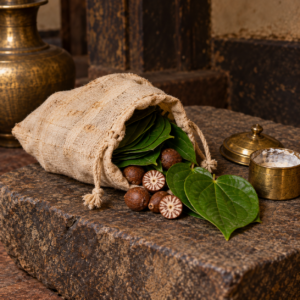
Alternate Names: Betel Pouch; Betel Nut Pouch
Short Description
Kodiyaale Cheela is a traditional cotton cloth pouch specially used to carry and keep betel leaves and arecanuts. A small box of lime paste, locally called Chunna Kotta, was also kept with the contents.
Full Description
Kodiyaale Cheela was a simple but useful personal pouch made from cotton cloth. It was used to carry the items required for preparing betel: betel leaves, arecanuts and a small container of lime paste called Chunna Kotta. Plain versions of the pouch were tucked into the pleats at the back of the traditional Kodava saree, allowing women to carry their betel ingredients conveniently while keeping their hands free.
Earlier, some Kodiyaale Cheela pouches were more elaborately decorated. Women from wealthier families who had greater exposure to embroidery incorporated embroidered borders and decorative work into their pouches.
Traditional Use
The pouch was used to carry and store betel leaves, arecanuts and Chunna Kotta for personal use and for sharing betel with others.
Design & Form
The basic pouch was a simple, lightweight cloth bag with an opening that could be gathered or closed. Plain versions were practical and unobtrusive, while more elaborate examples could feature embroidered borders and decorative detailing.
Materials
Traditionally made from cotton cloth. Decorative versions could include embroidered threadwork.
Contents
The traditional contents included:
- Betel leaves
- Arecanuts
- Chunna Kotta – a small box used to carry lime paste
Method of Making
The pouch was made by cutting and stitching cotton cloth into a small bag. The upper edge was finished to allow it to be gathered or secured. More decorative examples could be embellished with embroidery, particularly along the borders.
Traditional Knowledge
Making and decorating Kodiyaale Cheela required basic cloth-cutting, stitching and embroidery skills. Decorative embroidery reflected the craftsmanship and exposure of women who had learnt or developed such needlework techniques.
Cultural Context
Kodiyaale Cheela was closely connected with the traditional practice of carrying and consuming betel. Betel leaf and arecanut were part of social interaction and hospitality in earlier Kodava society. The pouch therefore served not merely as a container but as a practical personal accessory associated with everyday social life.
Traditional Location / Setting
Plain Kodiyaale Cheela was traditionally tucked into the pleats at the back of the Kodava saree, where it could be carried conveniently while moving about or participating in household and social activities.
Ritual & Practices
Betel was traditionally offered and consumed during social gatherings, hospitality and customary occasions. The Kodiyaale Cheela provided a convenient way of carrying the ingredients needed to prepare betel.
Historical Context
Kodiyaale Cheela belongs to an earlier period when betel consumption was a common part of social and domestic life. The pouch reflects the practical ways in which women carried personal items as part of traditional dress. Its placement within the saree pleats also demonstrates how clothing itself was used to accommodate everyday necessities.
Evolution & Changes
The pouch evolved from simple plain cotton versions to more decorative examples, with some incorporating embroidered borders and ornamentation. The availability of manufactured bags and changes in clothing and personal habits gradually reduced its use.
Reason for Decline
Kodiyaale Cheela has become extinct as a traditional everyday accessory, largely because betel consumption has declined considerably. Changing social attitudes towards arecanut consumption, including concerns about its harmful effects, have further contributed to the disappearance of the practice.
Present Status
The traditional Kodiyaale Cheela is no longer in regular use and is now primarily of heritage and historical interest.
Revival & Continued Use
Rather than reviving its former everyday use, the object can be preserved as an important example of traditional Kodava clothing, personal accessories and domestic practices through museum documentation and cultural displays.
Preservation
Surviving pouches should be documented for their fabric, size, construction, method of closure, embroidery, border designs and traditional method of carrying. The associated Chunna Kotta should also be documented as part of the complete betel-carrying set.
Virtual Modha goode
- The Balnji is one among many fascinating artifacts preserved in Virtiual Modhagood – The virtual Museum of Kodava Heritage. Explore more traditional objects, customs, and stories that showcase the rich cultural heritage of the Kodava community.
Comments
Leave a comment!Login for Post Comment
Last posts