

Kuri Kotta
Contents
Kuri Kotta ಕುರಿ ಕೊಟ್ಟ್
English Name: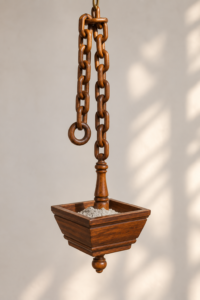
Traditional Vibhuthi / Sacred Ash Holder
Alternate Names:
Bhasma Holder; Vibhuthi Holder
Short Description:
Kuri Kotta is a traditional wooden hanging container used to hold kuri (bhasma or vibhuthi), the sacred ash used during religious and customary practices.
Full Description:
Kuri Kotta is a small wooden receptacle traditionally used for keeping sacred ash. The example shown consists of a wooden container suspended by a chain, allowing it to be hung in a designated place. Its elevated form makes the sacred ash readily accessible while keeping the container securely positioned.
Traditional Use:
Used to store and dispense kuri (bhasma/vibhuthi) for religious and customary purposes.
Design & Form:
The traditional form consists of a small, deep wooden receptacle with a shaped central wooden support and a suspension chain. The container is designed to remain securely suspended.
Materials:
Traditionally made of wood, with a metal chain used for suspension.
Method of Making:
The wooden container is carved and shaped by hand, with the central support and base carefully formed. A chain or similar suspension arrangement is attached to allow it to be hung securely.
Traditional Knowledge:
Its making reflects traditional woodworking skills, particularly the shaping of small functional wooden containers and the construction of simple suspension mechanisms.
Cultural Context:
Kuri Kotta is associated with the keeping of sacred ash and with traditional religious spaces. The sacred ash is an important part of customary worship and religious observances.
Traditional Location / Setting:
Traditionally kept in the Ainmane, particularly in the Bade near the Nellakki, and is also found in temples and village shires.
Ritual & Practices:
Kuri stored in the container is used as sacred ash during worship and customary religious practices. Its placement in a designated sacred space reflects the importance attached to keeping the ash respectfully.
Historical Context:
There is a possibility that the tradition of Kuri Kotta may have migrated from neighbouring Kerala, reflecting the historical cultural interactions between Kodagu and Kerala. Traditionally, it was kept in sacred areas of the Ainmane, especially in the Bade near the Nellakki, and was also used in temples and village shires.
Evolution & Changes:
While the traditional form was made primarily of wood and suspended using a chain, later examples may vary in construction and materials. Modern containers have also replaced such traditional holders in some places.
Reason for Decline:
The use of traditional wooden Kuri Kotta has reduced with the introduction of modern containers and changing practices in religious and household spaces.
Present Status:
Traditional examples survive as part of the material heritage of Ainmanes, temples and other sacred spaces. Their use may continue in places where customary practices are maintained.
Revival & Continued Use:
Documenting and retaining traditional Kuri Kotta in sacred spaces can help preserve both the object and the customary practice associated with it.
Preservation:
The object should be documented through photographs, dimensions, type of wood, carving and construction techniques, suspension mechanism, traditional location and manner of use. Oral histories should also record its association with the Ainmane, temples and shires.
Historical & Cultural Importance:
Kuri Kotta represents the intersection of woodcraft, sacred practice and traditional Kodava spaces. Its association with the Ainmane, Nellakki, temples and village shires makes it an important example of the material objects through which sacred practices were maintained and passed between generations.
Virtiual Modhagood
To explore more articles on Kodava heritage, customs, attire, artifacts, and traditions, visit Virtiual Modhagood – The virtual Museum
Comments
Leave a comment!Login for Post Comment
Last posts