

Nooputt Ural / Nooputt Ora
Nooputt Ora/Ural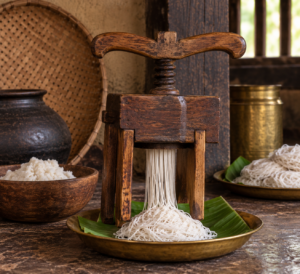
English Name
Traditional Wooden Noolputt Press
Alternate Names
Wooden Noolputt maker; traditional string-hopper press; wooden string-hopper equipment
Short Description
A traditional wooden kitchen implement used to make Noolputt (string hoppers) by pressing cooked rice dough into fine strands.
Full Description / Long Description
Nooputt Ora is a hand-operated wooden press traditionally used in the preparation of Noolputt. The implement consists of a sturdy wooden frame and a manually operated screw-and-handle mechanism. Prepared rice dough is placed into the lower pressing section, and the wooden handle is turned to apply pressure. The dough is forced through the small openings at the bottom, producing long, fine rice strands that are collected and arranged into Noolputt portions. The reference image shows the implement being used over a traditional brass plate lined with a banana leaf.
Traditional Use
Used for pressing cooked rice dough into fine strands while preparing Noolputt.
Design & Form
A compact upright wooden frame with two vertical supports, a rectangular pressing chamber and a central screw mechanism. A broad curved wooden handle at the top provides leverage for turning the screw and pressing the dough downward.
Materials
Primarily wood, with limited metal fittings or pins used in the screw, joints or moving mechanism.
Method of Making / Construction
The wooden body and supports are shaped from solid timber and joined to form a stable frame. A threaded central spindle is fitted with a broad wooden handle and connected to the pressing section. The lower portion contains the perforated outlet through which the rice dough is extruded.
Variants / Size
Traditional household models could differ in overall size, frame construction, handle shape and the fineness or arrangement of the extrusion holes.
Cultural / Functional Significance
The Nooputt Ora represents the traditional equipment and skill involved in preparing Noolputt by hand. It demonstrates how a simple mechanical device was adapted to an important rice-based food preparation.
Traditional Location / Setting
Traditional Kodava kitchens, particularly kitchens where rice was cooked and processed using wood-fired cooking and handmade implements.
Craftsmanship / Special Features
The combination of a hand-carved wooden frame and screw mechanism is its distinctive feature. The broad wooden handle provides leverage, allowing the cook to exert sufficient pressure to produce fine, uniform strands.
Reason for Decline
Traditional wooden presses have declined with the availability of modern metal and plastic Noolputt presses and commercially manufactured kitchen equipment.
Revival & Continued Use
The implement can be preserved through traditional-food demonstrations, heritage kitchens, cultural events and continued preparation of Noolputt using traditional methods.
Comments
Leave a comment!Login for Post Comment
Last posts