

suti
Contents
Suti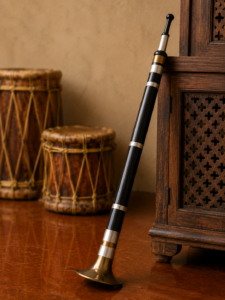
1. Object Name
Suti
2. Kodava Name
Suti
3. English Name
Flute-like Accompanying Instrument
4. Alternate Names
No alternate name is recorded for this instrument in the information provided.
5. Short Description
Suti is a simple flute-like wind instrument used along with the Mori during Valaga. Unlike a conventional flute, it has no finger holes and produces a continuous, flat tone.
6. Full Description
Suti is a simple traditional wind instrument used as an accompanying instrument in Valaga. It differs from the Mori in its construction and musical function. While Mori is capable of producing different notes through its finger holes, Suti has no finger holes and is designed to produce essentially a single, steady tone.
Its purpose is not to provide a melody but to maintain and reinforce the tonal base of the ensemble. The Suti is played alongside Mori to help the musicians remain in the same tone and scale, creating a more unified sound during the performance.
7. Traditional Use
Suti was traditionally played along with the Mori during Valaga, providing a continuous reference tone for the musical ensemble.
8. Design & Form
Suti has a simple, elongated tubular form. Its defining characteristic is the absence of finger holes. The uncomplicated design reflects its specific function as a supporting rather than melodic instrument.
9. Materials
Traditionally, Suti could be made from a suitable hollow tubular material, such as wood or bamboo, depending on the local method of construction.
10. Method of Making
The instrument is made by forming a hollow tube of the required length and preparing the ends for playing. Unlike a melodic flute, finger holes are not made along the body, allowing it to produce a fixed or relatively constant pitch.
11. Variants / Types
Variations may occur mainly in:
- Length
- Diameter
- Material
- Pitch or tonal range
These variations allow the Suti to be matched appropriately with the Mori being played.
12. Cultural / Functional Significance
The Suti has an important supporting role in Valaga music. Its steady tone provides a tonal reference against which the Mori can be played.
13. Historical Context
Suti belongs to the traditional musical practices associated with Valaga, where different instruments perform complementary roles rather than functioning independently.
14. Traditional Location / Setting
Suti was traditionally used during Valaga performances, particularly alongside the Mori as part of the ensemble.
15. Craftsmanship / Special Features
The most distinctive feature of Suti is its simplicity. The absence of finger holes is intentional and directly relates to its musical purpose.
Rather than producing a sequence of notes, it provides a stable tonal sound, helping the Mori player maintain the appropriate tone and scale.
16. Reason for Decline
Traditional instruments such as Suti have become less common as musical practices have changed and modern instruments and electronic amplification have become more prevalent.
17. Revival & Continued Use
The preservation of Valaga traditions provides an opportunity to preserve Suti as well. Documenting the instrument together with Mori is particularly important because its role is best understood within the ensemble rather than as a standalone instrument.
18. Preservation
Preservation should include:
- Photographing surviving Suti instruments
- Recording their dimensions
- Documenting the materials used
- Recording their pitch and tonal characteristics
- Documenting how Suti is played alongside Mori
- Recording traditional Valaga performances
- Collecting oral histories from musicians familiar with the instrument
19. Historical & Cultural Importance
Suti represents the supporting tonal tradition within the Valaga musical ensemble. Its simple, hole-less construction serves a precise musical purpose: producing a steady tone that helps establish and maintain the tone and scale of the Mori.
Unlike instruments designed to produce melodies, Suti demonstrates how traditional musical ensembles can use seemingly simple instruments to create tonal stability and musical coordination. Its preservation in the Modha Goode Virtual Museum is therefore important for understanding the complete structure of Valaga music and the complementary roles played by its individual instruments.
Comments
Leave a comment!Login for Post Comment
Last posts