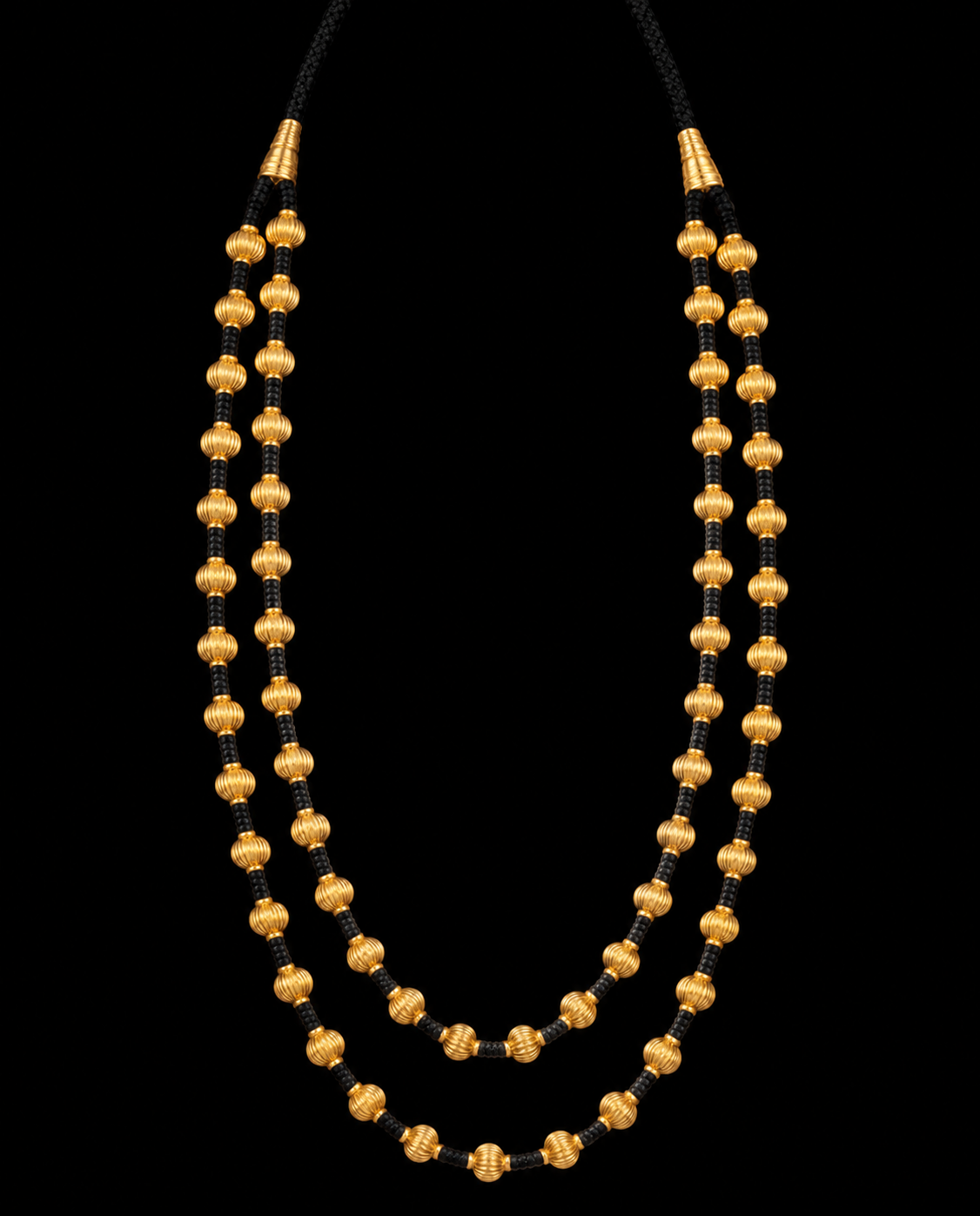
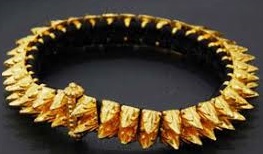
Jomale is a distinctive traditional necklace worn as part of Kodava bridal jewellery. It consists of gold and black moulded beads with grooves, arranged on a long black cord in two rows. The beads are hollow and are traditionally filled with lac, giving them their form and structure. The Jomale is long in length and arranged in two rows. It uses moulded beads with distinctive grooved surfaces, combining gold-coloured and black beads along a black cord.
Traditional use: The Jomale is traditionally worn by the Kodava bride as part of her wedding jewellery. It is specifically identified as a necessary part of a bride's jewellery during the traditional wedding ceremony.
Cultural significance: The Jomale has a significant place in Kodava wedding tradition because it forms an essential part of the bride's traditional jewellery ensemble. Its distinctive combination of gold, black beads, black cord and two-row arrangement contributes to the characteristic appearance of Kodava bridal attire.
Historical context: The Jomale belongs to the traditional jewellery heritage of Kodagu and has been associated with the traditional wedding attire of Kodava brides. Its construction using hollow beads filled with lac reflects traditional jewellery-making practices.
The beads are moulded into their characteristic grooved form and made hollow. The hollow beads are filled with lac, after which the gold and black beads are strung onto a black cord. The necklace is arranged into two long rows.
Reason for decline: Not declining
Revival efforts: The Jomale can be preserved through continued use in traditional Kodava weddings, documentation of surviving family heirlooms, recording its traditional construction and encouraging traditional jewellers to retain the characteristic gold-and-black grooved bead design.
You are preserving Jomale ಜೋಮಾಲೆ — Gold and Black Beaded Necklace.