

Kumbli Mara / Kummi Mara
Kumbli mara (Gmelina arborea Roxb.) one of the native trees in kodagu grows up to 30 m tall.It has a chlorophyll 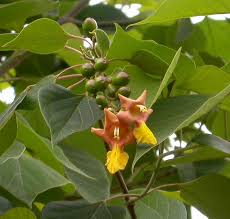 layer just under the outer bark, which is pale yellow on the outside and white inside. It is a fast-growing tree which grows on different localities and prefers moist fertile valleys.
Contents
Kodava
Kumbli mara
English
White teak
Kannada
Kashmiri mara, Shivanemara, Koolimara
Botanical Name
Gmelina arborea Roxb.
Family
VERBENACEAE
Flowering starts
May
Fruiting ends
August
Kummi Mara in Kodava Tradition
The importance of Kummi Mara goes beyond identifying a particular species of tree.Traditional Kodava life developed closely around the forests, fields and natural resources of Kodagu. Wood was essential to everyday life — from the construction of Ainmanes to agricultural implements and household objects.
Kummi wood was valued for its workable nature and was used in traditional craftsmanship.
Among the objects associated with Kummi Mara is the Dhudi, the small traditional drum used in Kodava cultural and ritual practices.The choice of wood was therefore not simply a matter of convenience.The tree became part of the object, and the object became part of the tradition.
The wood is quite strong and durable used for making furniture, panelling, musical instruments, match sticks, match box etc. The wood ash and fruits are used for dyeing. Fruits are eaten by wild animals.
The Wood of Kummi Mara
Kummi wood is generally:
- Light to moderately lightweight
- Relatively soft and easy to work
- Straight-grained to moderately interlocked
- Suitable for carving and turning
- Capable of taking a smooth finish
Traditional craftsmanship was therefore also an understanding of the forest.
Comments
Leave a comment!Login for Post Comment
Last posts