

Kachampuli
Contents
Kachampuli – The Traditional Souring Agent of Kodagu
Kachampuli is one of the distinctive ingredients of Kodagu (Coorg) cuisine. It is a dark, thick and intensely sour extract traditionally used to add acidity and depth of flavour to a variety of dishes, particularly meat preparations such as Pandhi Curry.
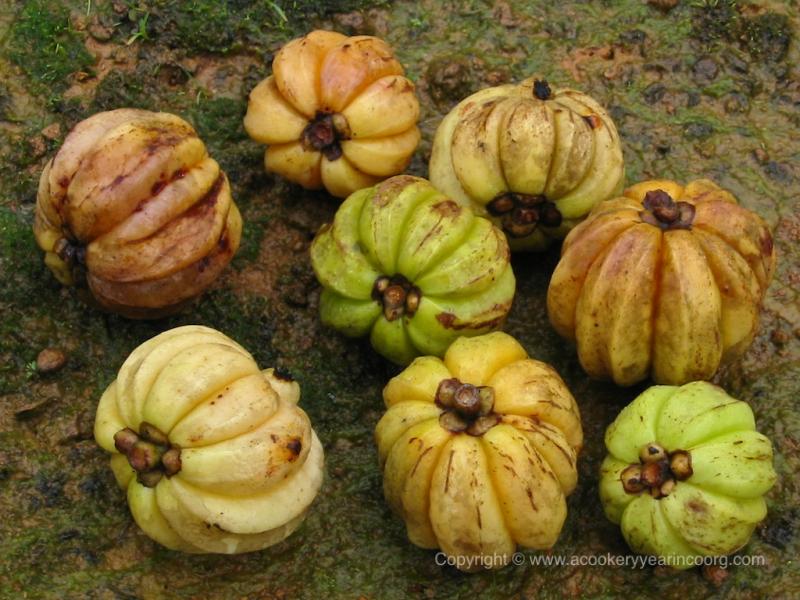
Kachampuli is prepared from the fruit of Garcinia gummi-gutta, a tropical plant belonging to the Garcinia genus. In the Kodava language, the fruit is traditionally known as Panapuli.
The characteristic sourness of Kachampuli has made it an important part of traditional Kodava cooking, and its use can be found across several preparations of Kodagu.
Panapuli and Kachampuli
Panapuli refers to the fruit, while Kachampuli is the concentrated sour extract prepared from it.
The transformation of the fruit into Kachampuli is a traditional preservation method that allows the souring agent to be stored and used over a long period.
Traditional Preparation of Kachampuli
The traditional preparation begins with the collection of ripe Panapuli fruits.
The juice is extracted from the fruit and then subjected to a prolonged boiling or reduction process. As water evaporates, the liquid gradually becomes darker, thicker and more concentrated.
The resulting dark, viscous extract is known as Kachampuli.
After boiling, the hot extract is allowed to cool before being transferred to glass or ceramic containers for storage.
Traditionally, Kachampuli is valued for its long keeping quality. In some households, an older, well-matured batch is considered particularly desirable for cooking because of its concentrated flavour and acidity.
Unlike many commercially produced souring agents, traditional Kachampuli does not require complicated processing. Its distinctive character comes from the fruit, concentration and storage process.
Kachampuli in Kodava Cuisine
Kachampuli is an important part of the flavour profile of several traditional Kodava dishes.
Only a relatively small quantity is generally required because the concentrated extract is intensely sour.
It is particularly well known for its use in Pandhi Curry, where its sharp acidity balances the richness of pork and complements the roasted spices used in the preparation.
It may also be used in other meat, fish and vegetable preparations where a distinctive sour note is desired.
The combination of Kartha Masala and Kachampuli is especially characteristic of traditional Kodava cooking.
Traditional Knowledge and Preservation
The preparation and use of Kachampuli illustrate how traditional communities developed methods of preserving seasonal produce for use throughout the year.
The fruit is available seasonally, but by converting its juice into a concentrated extract, it can be preserved for much longer periods.
The dark colour, thick consistency and strong acidity of Kachampuli are therefore not merely culinary characteristics—they are also the result of a traditional preservation practice.
Kachampuli and Garcinia – What Research Says
The fruit of Garcinia gummi-gutta contains hydroxycitric acid (HCA), a compound that has been studied for its possible effects on fat metabolism and weight management.
Some experimental and clinical studies have investigated whether HCA may influence appetite, fat synthesis and body weight. However, findings have been mixed, and the evidence is not strong enough to consider Kachampuli a proven weight-loss treatment.
Research has also examined the antioxidant and metabolic properties of compounds found in Garcinia species. These studies are of scientific interest, but laboratory findings should not automatically be interpreted as established health benefits from consuming traditional Kachampuli.
Kachampuli is primarily a culinary ingredient and traditional souring agent, rather than a medicine.
Other Traditional Uses
Kachampuli is not the only useful product obtained from the Panapuli fruit.
Traditionally, different parts of the fruit and plant have been put to various uses.
Seed Oil
The seeds of Panapuli (Garcinia gummi-gutta) also have a traditional culinary use in Kodagu. Oil extracted from the seeds was used in the preparation of Pondhi, an older traditional preparation of the region.
Pulp
The fruit dried pulp had traditional uses as well. KodavaClan records its use in the preparation of Pondhi, an older traditional preparation of Kodagu.
Preserving a Culinary Tradition
The knowledge of preparing Kachampuli has traditionally passed from one generation to another through household practice. Documenting the process helps preserve not only a recipe, but also the knowledge of seasonal harvesting, food preservation and traditional Kodava cuisine.
Kachampuli therefore represents an important example of how the people of Kodagu have transformed a locally available fruit into a long-lasting ingredient that continues to flavour their cuisine today.
Comments
Leave a comment!Login for Post Comment
Last posts