

Aal Potti ಆಲ್ ಪೊಟ್ಟಿ
Contents
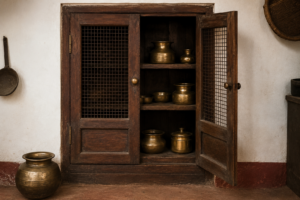
Aal Potti (ಆಲ್ ಪೊಟ್ಟಿ)
Overview
Aal Potti is a traditional storage cupboard found in old Kodava houses and Ainmanes of Kodagu. Traditionally positioned against a wall, usually in or near the kitchen, it was used to store cooked food, cooking vessels and other household utensils.The Aal Potti was a simple yet practical feature of the traditional Kodava kitchen, designed around the needs of everyday household life.
Traditional Design and Construction
Aal Pottis were generally constructed using wooden planks and shutters, with different varieties of locally available timber being used. An important feature of the traditional cupboard was its ventilated or mesh-like covering, which allowed air to circulate through the storage space.
This ventilation was particularly useful in the days before modern refrigeration. Cooked food that remained after a meal could be kept inside, while wet or recently washed vessels could also be placed there to dry with the help of natural airflow.
Function in the Traditional Household
The Aal Potti served several purposes:
- Storage of cooked food and leftover meals
- Storage of cooking vessels and utensils
- Temporary storage of wet vessels
- Protection of food and household articles from dust and insects
- Natural ventilation and drying through its mesh-covered sections
In this way, the Aal Potti was not merely a cupboard but an important part of the traditional kitchen system.
Historical Context
Aal Pottis are particularly associated with older houses and Ainmanes in Kodagu. Their presence in traditional wooden houses suggests that this form of storage has been used for generations.
The exact period when the Aal Potti first came into use is difficult to establish. Traditional Ainmanes themselves have evolved over many centuries, and similar built-in wooden storage features have formed part of their architecture for a long period.
Decline and Continuity
The Aal Potti has not completely disappeared. However, its traditional form has become increasingly uncommon as modern kitchens have adopted refrigerators, metal cupboards, modular storage systems and other contemporary materials.Today, surviving Aal Pottis in old independent houses and Ainmanes provide an important glimpse into how Kodava households traditionally stored food and utensils before modern household appliances became commonplace.
Where It Can Be Found
Traditional Aal Pottis may be seen in:
- Ainmanes
- Old Kodava houses
- Traditional kitchens and adjoining storage areas
Heritage Significance
The Aal Potti represents the practical ingenuity of traditional Kodava domestic architecture. It reflects a time when household storage was designed to work with the local climate, available materials and everyday needs.
Like many seemingly ordinary objects found in an Ainmane, the Aal Potti carries a story about how earlier generations lived, cooked, stored food and organised their homes. Preserving and documenting such objects helps ensure that the smaller details of Kodagu’s material culture are not lost.
Conservation Note
Where an original Aal Potti survives in an old house or Ainmane, it is valuable as a piece of Kodagu’s material heritage. Wherever possible, traditional cupboards should be documented, photographed and preserved rather than replaced, allowing future generations to understand the domestic life and craftsmanship of earlier Kodava households.
Virtual Modha goode
- To see many articles like these click on Virtiual Modhagood – The virtual Museum
Comments
Leave a comment!Login for Post Comment
Last posts