

thiri thook
Thiri Thook – ತಿರಿ ತೂಕ
English Name
Traditional Matchlock Gun
Short Description
An early traditional firearm operated using a burning wick, known as Thiri, to ignite gunpowder through a touch hole.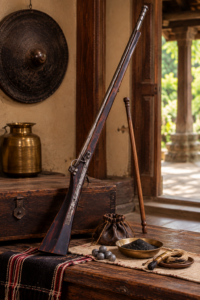
Full Description / Long Description
Thiri Thook was a traditional muzzle-loading firearm associated with an earlier period of Kodava martial and hunting traditions. The gun consisted of a long wooden stock, a metal barrel and a simple ignition mechanism in which a burning wick was brought into contact with a touch hole to ignite the gunpowder. Gunpowder and the projectile were loaded through the muzzle. An AchhKol, a small rod or stick associated with loading the gunpowder, was used as part of the loading process. The firearm represents the period when firearms became incorporated into the traditional martial culture of Kodagu.
Design & Form
A long, narrow firearm with a wooden stock and elongated metal barrel. The rear section forms the shoulder stock, while the ignition mechanism and wick are positioned near the breech.
Materials
Wood for the stock; forged iron or steel for the barrel and mechanical components; natural fibre or prepared material for the wick.
Method of Making / Construction
The wooden stock was shaped to hold the barrel securely. The metal barrel and ignition components were fabricated by traditional metalworking and fitted to the stock. A touch hole provided the route for ignition from the burning Thiri.
Variants / Size
Traditional firearms could vary considerably in barrel length, stock shape, metal fittings and ignition mechanism. Individual examples may also show differences resulting from local manufacture and repairs.
Cultural / Functional Significance
Thiri Thook marks an important transition in Kodava martial history—from earlier traditional weapons such as bows, arrows and blades to firearms. It became part of the material culture associated with protection, hunting and warfare.
Historical Context
The introduction and use of firearms added a new dimension to the martial traditions of Kodagu. The Thiri refers to the wick used for ignition, while Thook refers to the gun. The associated AchhKol was used as a loading stick for handling and filling the gunpowder during the loading process.
Traditional Location / Setting
Traditional Kodava homes, armoury or weapon-storage areas and settings associated with hunting, protection and martial traditions.
Craftsmanship / Special Features
Its distinctive matchlock ignition system, long barrel and wooden stock are characteristic features. The use of a separate Thiri for ignition and an AchhKol during loading illustrates the associated traditional firearm equipment.
Reason for Decline
Matchlock firearms became obsolete with the introduction of more advanced firearms and modern weapons. Changes in hunting practices and weapon regulations also contributed to their disappearance from everyday use.
Revival & Continued Use
Today, surviving Thiri Thook examples are primarily valuable as historical objects. They can be preserved through museums, heritage collections, oral-history projects and documentation of traditional Kodava martial culture.
Preservation
The firearm should be kept in a controlled, dry environment to protect its wooden stock and metal components from moisture, corrosion and deterioration. The Thiri, AchhKol, loading accessories and oral histories associated with the firearm should also be documented wherever surviving examples exist.
Historical & Cultural Importance
Thiri Thook represents an important stage in the evolution of Kodava martial material culture. Together with its Thiri wick and AchhKol loading implement, it provides evidence of how an earlier generation adapted firearms into established traditions of hunting, protection and martial life.
Comments
Leave a comment!Login for Post Comment
Last posts