

Kombh Vadya
Contents
Kombh Vadya 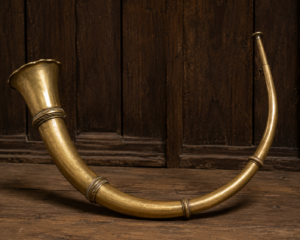
1. Object Name
Kombh Vadya
2. Kodava Name
Kombh Vadya
3. English Name
Traditional Horn Musical Instrument
4. Alternate Names
Kombu / Kombh may be used in connection with traditional horn instruments. The exact local naming may vary.
5. Short Description
Kombh Vadya is a traditional wind instrument made in the form of a curved horn, used as part of the musical ensemble accompanying Valaga performances and ceremonies.
6. Full Description / Long Description
Kombh Vadya is a traditional Kodava musical instrument characterised by its long, curved horn-like form. It is played by blowing into the mouthpiece and produces a deep, resonant sound.
The instrument forms part of the traditional Valaga, the ceremonial musical ensemble associated with important occasions in Kodava community life. Its powerful tone contributes to the distinctive soundscape of traditional Kodava ceremonies and processions.
The example shown is a curved metal horn with a flared mouthpiece and a narrow open end. Its construction reflects the traditional development of horn instruments designed to produce a strong sound capable of carrying across open spaces.
7. Traditional Use
Kombh Vadya was used during Valaga, particularly as part of traditional ceremonial music and processions.
8. Design & Form
The instrument has a characteristic curved, elongated body, gradually narrowing towards the mouthpiece and opening out at the opposite end.
Its curved form gives the instrument its distinctive appearance and contributes to its strong acoustic character.
9. Materials
Traditional examples may be made from:
- Metal, particularly brass or similar alloys
- Metal fittings and mouthpiece components
10. Method of Making
The body is formed into a long curved tube, with the joints and fittings carefully secured. The mouthpiece is shaped to allow the player to blow air into the instrument, while the wider opening allows the sound to project outward.
Traditional examples required skilled metalworking to achieve the correct curve and airtight construction.
11. Variants / Types
Variations may occur in:
- Overall length
- Degree of curvature
- Metal used
- Shape and size of the mouthpiece and bell
12. Cultural / Functional Significance
Kombh Vadya is an important component of traditional Kodava ceremonial music. Its deep and penetrating sound helps create the distinctive atmosphere associated with Valaga performances.
13. Historical Context
The instrument belongs to the older musical traditions of Kodagu in which wind and percussion instruments were played together during ceremonies and community occasions.
Its continued association with Valaga connects it with the ceremonial traditions of earlier generations.
14. Traditional Location / Setting
Kombh Vadya was traditionally heard during:
- Valaga
- Ceremonial gatherings
- Traditional processions
- Important community occasions
15. Craftsmanship / Special Features
The most recognisable feature of Kombh Vadya is its pronounced curved horn shape. Creating a long, smoothly curved and acoustically functional metal tube requires specialised craftsmanship.
Its large, open bell enables the instrument’s sound to project strongly over considerable distances.
16. Reason for Decline
The use of traditional musical instruments such as Kombh Vadya has declined with changes in ceremonial practices and the increasing use of modern musical instruments and amplified sound systems.
17. Revival & Continued Use
Traditional Valaga music continues to be valued as part of Kodava cultural heritage. Instruments such as Kombh Vadya can therefore be preserved and brought into cultural programmes, demonstrations and heritage events to ensure that the musical tradition remains familiar to younger generations.
18. Preservation
Preservation should include:
- Documenting surviving Kombh Vadya instruments
- Recording their dimensions and materials
- Photographing the instrument from multiple angles
- Recording performances by experienced players
- Documenting how the instrument is played within Valaga
- Recording oral histories of traditional musicians
19. Historical & Cultural Importance
Kombh Vadya represents an important part of the traditional musical heritage of Kodagu. Its powerful horn-like sound is associated with Valaga, linking the instrument directly to the ceremonial and communal traditions of the Kodava people.
As a physical object, its curved metal construction also represents the craftsmanship required to create traditional musical instruments. Preserving Kombh Vadya in the Modha Goode Virtual Museum helps document not only an individual musical instrument but also the sound, ceremony and collective cultural practices in which it was traditionally used.
Comments
Leave a comment!Login for Post Comment
Last posts