

Dhudi
Contents
Dhudi ದುಡಿ
The Traditional Kodava Hand Drum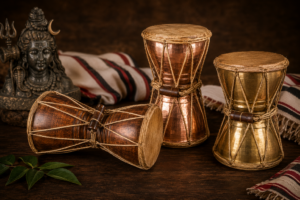
The Dhudi, also known as Dudi or Thudi, is a small, hourglass-shaped hand drum that holds an important place in the musical and oral traditions of the Kodavas of Kodagu.Its rhythm accompanies traditional Kodava songs, ritual performances and oral traditions, including Baalopaat and Battépaat. Small in size, yet distinctive in sound, the Dhudi has carried the rhythm of Kodava traditions across generations.
A Traditional Belief
According to Kodava oral tradition, the Dhudi has a much older connection with the community.
It is believed that Lord Shiva presented the Dhudi to the Kodavas as a token of his appreciation during the time of the Mahabharata. This belief places the instrument within the sacred and legendary traditions of the Kodavas, connecting the simple drum with a much older relationship between the community and the divine. Whether understood as sacred tradition or cultural memory, this story gives the Dhudi a significance that extends far beyond its role as a musical instrument.
Three Traditional Forms
Dhudis are traditionally found in three forms based on their material: wood, copper and brass.
The wooden Dhudi is traditionally carved from Kummi Mara, a locally known timber associated with the making of the instrument. Other Dhudis are crafted in copper or brass, giving them their distinctive metallic appearance and character.
Despite the difference in materials, the traditional form remains recognisable—a compact, waisted body with a drumhead stretched across each end.
Construction and Sound
The two ends of the Dhudi are covered with animal hide, carefully stretched and secured to the body. The tension of the drumheads determines the character of its sound.
A distinctive feature is the Murk, the central grip or mechanism associated with the drum. The performer can manipulate it while playing, influencing the tension, pitch and intensity of the sound.
Played by hand, the Dhudi can provide a continuous rhythmic pulse while the performer sings or participates in the performance.
The Rhythm of Oral Tradition
The Dhudi is closely connected with the oral heritage of Kodagu. In earlier generations, songs and performances were important ways of preserving stories, traditions and collective memory.
In Baalopaat and Battépaat, the Dhudi provides the rhythmic foundation around which the voice and narrative unfold. Its beat gives structure to songs and stories passed from one generation to the next.
More Than a Drum
For the Kodavas, the Dhudi is therefore more than a percussion instrument. Through its traditional association with Lord Shiva, its place in oral tradition, and its continuing role in music and ritual, it carries layers of cultural memory.
From a simple drum carved from Kummi Mara to finely crafted examples in copper and brass, the Dhudi remains a living link between legend, music, storytelling and Kodava heritage.
Virtual Modha goode
- Virtiual Modhagood – The virtual Museum of Kodava Heritage.
Comments
Leave a comment!Login for Post Comment
Last posts