

Akki Pittari / Akki Potti
Contents
Akki Pittari / Akki Potti (ಅಕ್ಕಿ ಪಿಟ್ಟಾರಿ / ಅಕ್ಕಿ ಪೊಟ್ಟಿ)
Overview. 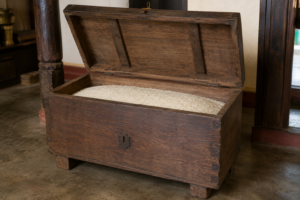
Akki Pittari, also known as Akki Potti, is a traditional wooden storage container used for storing rice and other grains in Kodava households.
Rice has long been an important part of the food and agricultural traditions of Kodagu. The Akki Pittari provided a practical way of storing harvested grain safely within the household, helping protect it from moisture, insects and other forms of spoilage.
Traditional Grain Storage
In earlier times, many Kodava households cultivated and stored their own rice. After harvesting and processing the grain, a large portion was kept aside for household consumption and replanting at pathaya
The Akki Pittari provided a dedicated storage space for daily or weekly reserve. Its enclosed wooden construction helped keep the grain protected while allowing households to maintain a supply of rice for an extended period.
Design and Construction
The Akki Pittari was traditionally made from wood, using sturdy boards joined together to form a strong storage container.The design was primarily functional. Thick wooden walls and a secure lid helped protect the contents from humidity, insects and rodents. The size of the container could vary depending on the household and the quantity of grain that needed to be stored.
Traditional carpentry techniques allowed these containers to remain useful for many years.
Importance in Household Life
The Akki Pittari was more than a storage box. It was connected to the agricultural cycle of the household.Rice harvested from the fields represented the result of months of cultivation and labour. Storing it safely was therefore an important responsibility. A well-maintained grain container helped ensure that the household had food available between harvests.
In this sense, the Akki Pittari was part of a traditional system of food security and household self-sufficiency.
Rice and Kodagu’s Agricultural Heritage
The history of rice cultivation is closely connected with the landscape of Kodagu. Paddy fields, streams and traditional agricultural practices shaped rural life for generations.The Akki Pittari represents the final stage of this cycle—from cultivation and harvesting to storage and consumption.
It therefore provides a tangible connection between the traditional Kodava household and the agricultural landscape surrounding it.
Heritage Significance
Today, traditional wooden grain-storage containers are becoming increasingly uncommon as modern metal, plastic and concrete storage systems have replaced them.An Akki Pittari preserved in an old house or Ainmane is therefore an important example of Kodagu’s agricultural and domestic material heritage.*It reminds us of a time when households depended heavily on their own harvests and carefully planned the storage of food for the months ahead.
Museum Note
The Akki Pittari / Akki Potti is preserved as an example of traditional grain-storage technology in Kodagu, illustrating the craftsmanship, agricultural knowledge and food-preservation practices of earlier generations.
Virtual Modha goode
- Virtiual Modhagood – The virtual Museum of Kodava Heritage.
Comments
Leave a comment!Login for Post Comment
Last posts