

Kuppanda Ainmane
Contents
Kuppanda Ainmane
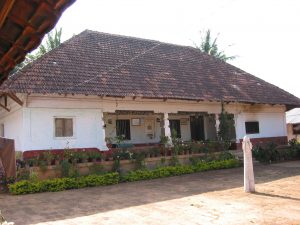
Kuppanda Ainmane is the ancestral house of the Kuppanda Okka, a Kodava clan located at Nangala in the Vaipalli Kēri of Kodagu, Karnataka, India. The ainmane is associated with Kuppanda-1, one of the branches of the Kuppanda Okka.
Location
Village: Nangala
The Kuppanda Okka
The Kuppanda Okka is traditionally associated with the ancestral home at Nangala and with a number of ritual and community responsibilities in the surrounding area.
History of the Ainmane
The present Kuppanda Ainmane is believed to be the second Ainmane constructed at the location.
According to the recorded family account, the earlier house was accidentally destroyed by fire. The fire reportedly occurred when an elderly woman went into the attic carrying a lamp with a flame. The present house was subsequently constructed, with its mane mangala dated to 1842–43.
The roof was later converted to a tiled roof in 1865. The thethi, verandah and hall were cemented in 1974, while some rooms continued to retain traditional mud floors that had been washed with cow dung
These successive changes illustrate the way many ainmanes have evolved while retaining important elements of their original architectural and ritual character.
Architecture
Kuppanda Ainmane is an Othé Poré, a traditional Kodava house form characterised by a large roof and substantial verandah.
The house has a high roof and a large front verandah. The yard in front of the house is paved with laterite stones, a material widely associated with the traditional architecture of Kodagu.
At the entrance is an Ubba, accompanied by two stone posts. A Kall Boti stands in the front yard.
The house contains ten rooms, including the kitchen.
Verandah and Woodwork
The verandah contains two doors with carved doorframes, one carved window and two plain windows fitted with bars.
The wooden Aimaras, or built-in seating platforms, are an important part of the traditional interior. An older Aymara on the eastern side of the verandah was damaged by Mooli Thēn, described in the field documentation as tiny bees, and was subsequently replaced with a cemented structure.
The long Aymara along the western interior wall of the verandah and another along the eastern wall of the hall are made from Ajini wood. According to the recorded account, this timber was brought by villagers from approximately eight kilometres away.
Bhasma Kutt
The hall contains a large Bhasma Kutt, a traditional wooden container associated with sacred ash. Both the container and its chain are made from a single piece of wood.
Roof
The original roof was subsequently tiled in 1865. The high roof is one of the prominent visual characteristics of the house.
Meedi
The Kuppanda tradition maintains the Meedi in the Kanni Kombare rather than in the former Kaimada.
The Meedi represents the continuing ritual relationship between the living members of the okka and their ancestors.
Kaimada
The Kuppanda Kaimada is no longer standing. According to the recorded account, it collapsed more than 100 year agoAfter its collapse, the Meedi continued to be maintained within the Kanni Kombare of the ainmane.
A family member subsequently constructed a house at the former site of the Kaimada. The family account regards this as a violation of the sacred character of the site and associates the event with subsequent misfortune.
Al Rupa
An important ancestral ritual associated with the Kuppanda Okka is the preparation of an Al Rupa, a silver representation associated with an ancestor.According to the recorded family tradition, the silver Al Rupa is immersed in the Kundiké at Talacauvery following two days of worship at the village Bhadrakali Temple.The Al Rupa is not brought into the ainmane. Instead, it is kept tied to a jackfruit tree until the time of immersion. This practice reflects the wider importance of ancestral worship in Kodava society, where the memory and presence of ancestors continue to be integrated into family rituals.
Kuppanda Thakkame
The Kuppanda Okka traditionally holds the Deva Thakka rights of the Bhadrakali Temple.The responsibilities associated with this position include the custody of valuable temple articles and the Bhandara Potti, the sacred treasury or container associated with the temple.The Kudré, or ceremonial horse used during the Bhadrakali Bōd Nammé, proceeds from the Kuppanda Ainmane.According to the recorded account, the same horse frame is retained from year to year rather than dismantled after each festival. For the Parana Mani Nammé, however, a new horse frame is made annually.
Festivals and Rituals
- The principal festival specifically recorded as being celebrated at the ainmane is Karanang Kodpa, an ancestral ritual associated with the veneration of the Karanava and other ancestors.
- During Puthari, members of the okka who live near the ainmane gather there, while those living farther away traditionally conduct the corresponding observances in their own homes.
- The house therefore continues to function as a ritual centre even though it is no longer the everyday residence of the entire okka.
The Karanava recorded for Kuppanda-1 is Madayya.
The Karanava occupies an important place in the traditional ancestral structure of a Kodava okka. The ancestral presence is represented through ritual practices associated with the ainmane, Kaimada and Meedi.
Branches of the Kuppanda Okka
According to the recorded family tradition, the Kuppanda Okka has two principal branches.
Kuppanda-1
Kuppanda-1 retains the ancestral ainmane at Nangala.
Kuppanda-2
The second branch is known as Panyath Mane Kuppanda and established its ainmane at Kaikeri.
Comments
Leave a comment!Login for Post Comment
Last posts