

Beejo Kall / Beejwa Kal
Contents
Beejo Kall / Beejwa Kal (ಬೀಜೋ ಕಲ್ಲು / ಬೀಜ್ವ ಕಲ್)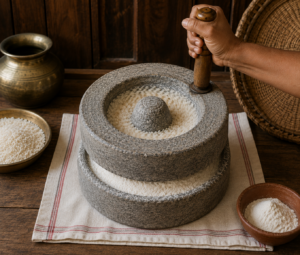
Beejo Kall, also known as Beejwa Kal, is a traditional stone hand mill used for grinding and processing grains, pulses, spices, and other food ingredients. Made from a pair of heavy, naturally durable stone discs, it was once an important part of the traditional kitchen in Kodagu.
The mill consists of a lower stationary stone and an upper rotating stone. The upper stone has a central opening through which the grain or other ingredients are introduced. A wooden handle fixed to the upper stone allows it to be rotated manually, gradually crushing and grinding the material between the two stones.
Traditional Material
- Granite or other hard natural stone
- Wooden handle
- Natural materials used for construction and fitting
Traditional Use
Beejo Kall was used for:
- Grinding grains and pulses
- Crushing spices and dry ingredients
- Preparing flour and other food preparations
- Processing small quantities of ingredients for daily cooking
The hand-operated design allowed ingredients to be ground gradually, giving the user control over the texture and consistency.
Design and Construction
The Beejo Kall consists of two closely fitted circular stones. The lower stone remains stationary, while the upper stone rotates around a central point.
A wooden handle is attached to the upper stone, replacing the modern metal handle seen on many later versions. The handle provided the leverage needed to turn the heavy stone by hand.
The rough surface of the stones helped crush the ingredients effectively as the upper stone moved over the lower one.
Use in the Traditional Kitchen
Before electric grinders and mechanised milling equipment became common, grinding was an everyday household activity. The Beejo Kall provided a simple and dependable way to process food using human effort and locally available stone.
It was particularly useful for preparing ingredients in small quantities and was part of the rhythm of traditional kitchen life.
Why It Became Rare
The use of Beejo Kall declined with the introduction of electric mixers, grinders, flour mills, and other mechanised kitchen appliances. These alternatives made grinding faster and required considerably less physical effort.
Changing lifestyles and the decline of traditional household food-processing practices further reduced the need for hand-operated stone mills. As modern kitchens became more compact and appliance-based, large stone grinders gradually disappeared from everyday use.
Heritage Significance
Beejo Kall represents an important part of the traditional food culture and domestic life of Kodagu. It reflects a time when food was prepared largely by hand and household implements were made from durable, locally available materials.
The combination of stone and wood, simple mechanical design, and manual operation demonstrates the practical knowledge of earlier generations.
Today, Beejo Kall is primarily a heritage object, preserved as a reminder of traditional kitchens, food preparation, craftsmanship, and the self-sufficient way of life once common in Kodagu.
Museum Note
Beejo Kall / Beejwa Kal is preserved as an example of traditional Kodava kitchen technology—a manually operated stone mill that transformed grains, pulses, spices, and other ingredients through simple mechanical action, long before modern electric grinders became part of everyday life.
Virtual Modha goode
- Virtiual Modhagood – The virtual Museum of Kodava Heritage.
Comments
Leave a comment!Login for Post Comment
Last posts