

The Coorg Regiment
The Coorg Regiment tradition is not a single uninterrupted infantry regiment, but a continuum of military service, reorganizations, and cultural survival.
While early lineages predate Kodava-specific recruitment, the martial identity of Kodavas found formal regimental expression in 1903 and again in 1942, and lives on today through the 37 (Coorg) Regiment of Artillery.
Below is a clean, chronological timeline. the list of all personells of defence is mentioned
Contents
Timeline: Lineage of the Coorg Regiment Tradition (1767–Present) 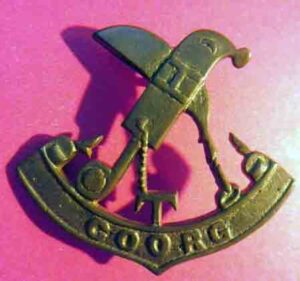
1767
- Raised as the 15th Battalion Coast Sepoys under the Madras Army of the East India Company.
- This unit forms the earliest recorded institutional lineage later connected to the Coorg regimental experiment.
1796
- As part of a major reorganization of the Madras Army, the unit was renumbered and redesignated as the
2nd Battalion, 9th Madras Native Infantry. - This was not a disbandment and not a Coorg-specific unit, but a routine administrative restructuring common in the late 18th century British Indian Army.
Early–Mid 19th Century
- The regiment continued to exist under successive Madras Native Infantry designations, undergoing periodic renumbering and role adjustments.
- Kodavas during this period served independently as soldiers, officers, and irregular levies, but not yet as a distinct regimental class.
1901–1903
- A formal attempt was made to raise a Coorg class regiment.
- In 1903, the unit was officially redesignated as the 71st Coorg Rifles.
- Despite the name, recruitment from Kodagu proved limited due to the small population, and the regiment struggled to sustain numbers.
1904
- The 71st Coorg Rifles was disbanded.
- This marked the end of the first formal Coorg infantry regiment.
- Kodava soldiers were thereafter absorbed into other regiments of the British Indian Army.
1914–1918 (World War I)
- Kodavas served with distinction across various Indian Army units.
- Several Kodava officers and soldiers earned gallantry decorations, including the Military Cross.
1939–1945 (World War II)
- Renewed recognition of Kodava martial tradition led to the raising of a new unit.
1942
- The 1st Coorg Battalion was raised during World War II.
- This was the second and most significant formal regimental recognition of Kodavas as a distinct martial group.
1946
- Post-war military restructuring led to the conversion of the 1st Coorg Battalion into an Anti-Tank Artillery Regiment.
- The unit entered the Regiment of Artillery, marking a shift from infantry to artillery.
Post-Independence (Late 1940s–1950s)
- The unit underwent several redesignations as military technology and doctrine evolved:
- Anti-Tank Regiment
- Heavy Mortar Regiment
- Light Regiment
- Medium / Field Regiment
Present Day
The regiment survives today as 37 (Coorg) Regiment, Regiment of Artillery, preserving Coorg ceremonial customs and identity. It represents the continuing institutional embodiment of the Coorg regimental tradition within the modern Indian Army
- The unit exists as 37 (Coorg) Regiment, Regiment of Artillery.
- It is the sole living institutional descendant of the Coorg regimental tradition.
- The regiment preserves distinct Coorg identifiers:
- War cry invoking Kaveri : Now or never jai kaveri maatha
- Ceremonial use of kupya and pichangatti ( peechekathi )
- Continued cultural association with Kodagu
Related Video
You tube : Link between Indian Artillery & American National Anthem
Comments
Leave a comment!Login for Post Comment
Last posts