

Karpa chekke
Contents
Karpa Chekke (Cinnamomum malabatrum)
Overview
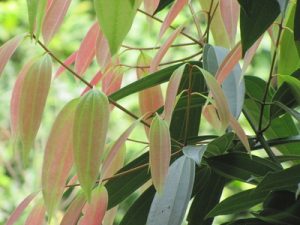
Karpa Chekke (Cinnamomum malabatrum (Burm.f.) Blume) is an evergreen tree belonging to the Lauraceae (laurel) family. It is one of the native tree species of Kodagu (Coorg), Karnataka, where it naturally occurs in the evergreen and semi-evergreen forests of the Western Ghats. The tree is well known for its highly aromatic leaves, which have been used for centuries as a culinary spice and in traditional Ayurvedic medicine.
The leaves, commonly known as Indian Bay Leaf or Malabar Leaf, are an important non-timber forest product and are valued for their distinctive fragrance, which resembles a blend of cinnamon and clove. In Kodagu, the tree has long been associated with traditional cooking and indigenous herbal remedies.
Taxonomy
| Rank | Classification |
|---|---|
| Kingdom | Plantae |
| Clade | Angiosperms |
| Clade | Magnoliids |
| Order | Laurales |
| Family | Lauraceae |
| Genus | Cinnamomum |
| Species | Cinnamomum malabatrum (Burm.f.) Blume |
Local Names
| Language | Name |
|---|---|
| Kodava | Karpa Chekke, Naru Mara, Nernge Mara |
| Kannada | Lavangada Yele |
| English | Indian Bay Leaf, Malabar Leaf |
Description
Karpa Chekke is a medium-sized evergreen tree that typically grows up to 15 metres (49 ft) in height, although mature specimens may occasionally grow taller under favourable forest conditions.
The tree has a straight trunk with smooth brown bark that emits a pleasant aromatic fragrance when cut or bruised. The inner bark is pale brown and possesses a characteristic spicy aroma due to the presence of essential oils.
The leaves are simple, leathery, glossy, and elliptic to ovate in shape. They are prominently three-nerved from the base, a characteristic feature of many members of the Lauraceae family. When crushed, the leaves release a warm aromatic scent similar to cinnamon, clove, and nutmeg.
The tree bears small, pale greenish-yellow flowers arranged in clusters. These develop into small, oval berries that turn dark purple to black upon ripening.
Distribution and Habitat
Cinnamomum malabatrum is native to the Western Ghats of India, one of the world’s biodiversity hotspots.
In Karnataka, it is naturally found throughout the forests of Kodagu, especially in moist evergreen forests, shola forests, and riverine habitats. It also occurs in parts of Kerala, Tamil Nadu, Goa, and Maharashtra.
The species thrives in:
- Tropical evergreen forests
- Semi-evergreen forests
- Moist deciduous forests
- Elevations ranging from approximately 600–1,800 metres
Kodagu’s cool climate, abundant rainfall, and fertile forest soils provide ideal growing conditions for the species.
Flowering and Fruiting
| Activity | Period |
|---|---|
| Flowering | January |
| Fruiting | February – April |
The flowers attract a variety of insects that aid in pollination, while the fruits are consumed by birds, which assist in seed dispersal throughout the forest.
Uses
Culinary Uses
The aromatic leaves are widely used as a flavouring agent in Kodava cuisine. They are commonly added to:
- Rice dishes
- Biryani
- Pulav
- Curries
- Meat preparations
- Traditional Kodava recipes
The leaves impart a warm, mildly sweet, spicy aroma and are typically removed before serving.
Medicinal Uses
Karpa Chekke has been valued in traditional Ayurvedic and folk medicine for generations.
The leaves and bark contain essential oils rich in natural aromatic compounds and have traditionally been used for:
- Improving digestion
- Relieving flatulence
- Treating colds and coughs
- Supporting respiratory health
- Reducing inflammation
- Preparing herbal decoctions and medicinal oils
Modern phytochemical studies have shown that the leaves possess antioxidant, antimicrobial, and anti-inflammatory properties, supporting many of their traditional medicinal uses.
Other Uses
- Leaves are distilled to extract essential oils.
- Wood is occasionally used for small household implements.
- The tree contributes to forest biodiversity by providing food and shelter for insects, birds, and other wildlife.
Ecological Importance
Karpa Chekke plays an important ecological role in the forests of Kodagu. As a native evergreen species, it contributes to maintaining forest structure and provides habitat for numerous birds, insects, and small mammals. Its fruits serve as a food source for several frugivorous bird species, which aid in natural seed dispersal.
The species also helps conserve soil moisture and supports the health of the Western Ghats ecosystem.
Conservation
Although Cinnamomum malabatrum remains relatively common in suitable habitats, local populations may be affected by:
- Habitat fragmentation
- Unsustainable harvesting of leaves and bark
- Expansion of plantations and agriculture
Conservation of Kodagu’s natural forests is essential to ensure the long-term survival of this valuable native tree and the many species that depend upon it.
Comments
Leave a comment!Login for Post Comment
Last posts