

Gejje Thand
Contents
Gejje Thand
Gejje Thand is a sacred ceremonial staff of the Kodava people of Kodagu (Coorg), Karnataka, India. It is traditionally owned by each okka (clan) and held by male members during important rituals, spirit possession ceremonies, and life-cycle events. The Gejje Thand is regarded as a powerful symbol of authority, sanctity, protection, and ancestral continuity in Kodava culture.
Etymology
The term Gejje refers to bells, and Thand means staff or wand in Kodava usage. The name denotes a staff adorned with small silver bells.
Description
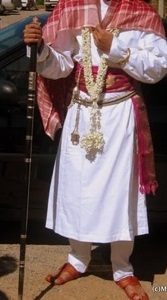
The Gejje Thand is traditionally crafted from Kari Mara ( ebony ),. It is fitted with multiple silver bands known as bolli murr, and the upper portion is rimmed with gejje (small silver bells). The staff is considered a sacred object and is handled only in ritual contexts.
Cultural and Ritual Significance
The Gejje Thand is held by male Kodava members during major ceremonial occasions. It is closely associated with spirit possession rituals and ancestral invocation.
Karona Ajja
Similarly, during possessions attributed to Karona Ajja, the Gejje Thand is held by the male participant, signifying ancestral legitimacy and continuity.
Role in Marriage Ceremonies
In traditional Kodava weddings, the groom holds the Gejje Thand on the day of marriage. The sanctity of the staff is considered so high that in rare historical instances where the groom was compelled to leave the ceremony due to unavoidable circumstances, the bride was symbolically married to the Gejje Thand, which served as a ceremonial representation of the groom.
Sanctity and Storage
The Gejje Thand is not kept in open view in ordinary houses. It is usually placed in the kanni kombare (sacred corner) of the ainmane (ancestral house). It is treated as a living sacred object, believed to be under the spiritual guardianship of the moolapurusha (clan ancestor).
Origin Beliefs
According to Kodava oral tradition, the Gejje Thand was bestowed upon the Kodavas by Lord Maheshwara (Shiva). It is believed that the staff was carved from his trident and given as a symbol of authority and protection. In the same tradition, Shiva also granted the Dudi (ritual drum) to the Kodavas, whose beat is believed to awaken spirits and guide rituals in every oor (village).
Anuvada Ritual
When a new Gejje Thand is required for an Okka, it is traditionally crafted with strict ritual devotion and taken to the Makki Sasthav Temple for blessing. This ceremonial presentation and consecration is known as Anuvada. Only after this rite is the staff considered ritually valid for use for the spiritual purposes especially on there .
Inheritance and Lineage
The Gejje Thand is transmitted through the male line as a hereditary sacred object. Traditionally, the eldest son inherits the Gejje Thand from his father. At the time of this inheritance, a ring known as the Muru is added to the staff. The Muru symbolises the continuation and validation of lineage, and each addition marks generational succession. Over time, the accumulation of Muru rings serves as a physical record of ancestry.
Younger sons do not receive the ancestral Gejje Thand. Instead, at the time of their marriage, a new Gejje Thand is ceremonially commissioned for them and consecrated through the Anuvada ritual. This newly established staff then becomes their lineage Gejje Thand and is subsequently passed on to their own eldest sons, following the same hereditary pattern.
Through this system, every branch of the okka maintains its own Gejje Thand, while the original ancestral staff continues along the senior-most line, preserving both genealogical order and ritual continuity.
Comments
Leave a comment!Login for Post Comment
Last posts