
chowri aat
Contents
Chowri-aat (ಚೌರಿಯಾಟ್)
From Leaves to the Chowri
Chowriya-aat is a traditional Kodava dance distinguished today by the use of the chowri, the flowing yak-hair whisk traditionally associated with ceremonial and royal settings.The graceful movement of the chowri gives the dance its distinctive character. However, according to Kodava oral tradition, the use of the chowri represents a later development in the evolution of the performance.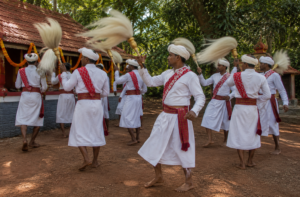
Before the Chowri
The older form of the tradition is remembered as having used small branches, twigs or leafy stems rather than the chowri.These natural objects represented the surrounding forest and the living world of Kodagu. The dancers carried them while performing rhythmic movements, bringing the imagery of nature into the ceremonial performance.
This older form is particularly significant when considered alongside Komb-aat and Peelya-aat.
Komb-aat used the deer’s horns.
Peelya-aat used peacock feathers.
The earlier form of Chowriya-aat used leaves and branches. Together, they created a powerful vocabulary through which the natural world was represented in dance.
The Arrival of the Chowri
Kodava oral tradition holds that the chowri came into the tradition at a later period through cultural influences associated with rulers and royal ceremonial practices.
The yak was not native to Kodagu, and therefore a yak-hair chowri was not originally a naturally available object within the region.
As cultural contacts changed over time, the chowri was adopted as a ceremonial object. Its long flowing hair, elegant movement and association with royal ceremony gave the dance a more elaborate appearance.
The older leafy branches were gradually replaced by the chowri.
A Change in the Prop, Not the Spirit
The change from leaves to chowri illustrates how traditions evolve.The object changed, but the movement and ceremonial character of the performance could continue. What was once represented through a simple branch from the forest eventually came to be represented by an object carrying associations of ceremony, dignity and royalty.In this sense, Chowriya-aat also tells a story about cultural exchange and adaptation.
Connected to Komb-aat and Peelya-aat
Chowriya-aat is traditionally spoken of alongside Komb-aat and Peelya-aat.
The three dances use different objects to create a visual connection with the natural and ceremonial world:
Komb-aat — Deer horn
Peelya-aat — Peacock feather
Chowriya-aat — Leaves, later the chowri
Seen together, they form a fascinating record of how Kodava performing traditions incorporated elements from both the natural environment of Kodagu and later cultural influences.
A Living Heritage
Today, the chowri gives Chowriya-aat its distinctive identity. Its flowing movement adds grace and visual richness to the performance.
Yet behind the modern prop lies an older memory—the simple branch and leaf, the forest surrounding the community, and the idea of bringing nature into the ritual space.
Chowriya-aat is therefore not only a dance of the chowri. It is also a reminder of how traditions change while carrying their older memories forward.
Comments
Leave a comment!Login for Post Comment
Last posts